Adventures in genealogy: Visiting Old St. Andrew's Church, Charleston, South Carolina

Old St. Andrew's Church is located in the West Ashley area of Charleston - that's on the other side of the Ashley River from the main city, on the same side as Charles Towne Landing. It is the oldest surviving church in South Carolina, one of ten Church of England parishes established by the Church Act of 1706. This is the church my family belonged to at that very time, the early 1700s, which is why I wanted to see it - the building where they worshipped and the surrounding landscape in which they lived. It was the one thing I was dead-set on seeing in Charleston. I did not think it would be such an adventure to get there.

I had no car, so I went to the Charleston Visitors Center at about 9 in the morning and said to the very nice young girl behind the counter, "I'm interested in seeing Old St. Andrew's Church. How do I get there by bus?" To which she replied, "Oh, you can't get there by bus."

Lovely.

As it turns out, you can get there by bus, but not easily. My journey started, appropriately enough, on Mary Street behind the center, where I caught a 10:20 Route 30 bus across the river to the Citadel Mall in West Ashley. I was suddenly smack dab in suburbia. Except for the palm trees I might as well have been home. The girl at the visitors center had told me to transfer to the 302 bus toward Shadowmoss and to ask the bus driver the best stop to get off for St. Andrew's. Well, I didn't know where to catch the 302 - turns out, it's from the same exact stop at the Citadel Mall where I had been dropped off. The intense heat had me confused. As did the sign for that route that only said Orange Grove, which was the direction opposite the one I wanted. So while I was figuring all this out, I missed the connecting 302. Which was just as well because I needed more comfortable shoes, which I was able to get at Target. I was annoyed about spending my free day on vacation at the mall of all places, but that extra time helped me figure out that the 302 would have been the wrong bus. The extra time AND the walking a mile and a half or so up the road toward Ashley River Road to see what was going on with these bus stops. A mile and a half or so in 90 degree heat with tons of humidity. No wonder I got a sunburn. My hair was frizzy and wild and I was sweating and I probably looked a little like a crazy person, what with the way I looked and the mumbling to myself trying to figure out what was what - I didn't care. I was going to get to this church, even if I had to walk the whole way there.

I almost had to. I knew what bus route I needed to be on now but I didn't have a timetable for that route, so I didn't know how often the bus was running, if I'd have to wait 30 seconds or 30 minutes. But thank God for my smartphone, because I was able to look up what I needed to know (except for the timetable) and use my GPS to figure out where I was going. I would have been completely lost without it.

I think I finally got to the church about 1:30. Yes, it took me all day to get there. But it was worth it. Because no longer was I in suburbia. I was on a quiet road in the middle of the woods, next to the marshes and the water, surrounded by palm trees and magnolia trees and peace and quiet. It was so, so beautiful. Yes, there were cars and some other sides of modernity but suddenly I was not only in the place but the time that my family lived. There was a beautiful fountain and lake, which looked fairly modern, but there was an old cemetery on the grounds, which if you follow my blog, you know made me very happy. There's nothing I love more than wandering around an old cemetery for a few hours. Most of the graves were too "new" for me - 1800s and such - although I did find one that would have been a contemporary of my ancestors, so that was cool. I took some photos and basically just hung out, walking around, for awhile. In places like that, old places, you can feel history come alive. To call it a cosmic connection might go a little too far, but it's like something in the past and something in the present reach out to each other and touch, if even for just a second. Besides all the good information you can find from doing onsite research, standing where your ancestors stood, seeing what they saw, hearing what they heard, and feeling what they felt, is another perk of visiting the places where your family came from.

A quick genealogy break on an otherwise swamped Tuesday...

It's just one of those days where I'm getting bogged down in work both inside and outside of the office but it occurred to me at some point over the past couple of days that two of my great loves, genealogy and writing, are actually very similar, in that they're both extremely interdisciplinary in nature. They both require research and organization, but in order to do genealogy properly, you need to not only know history, you need to know geography, you need to know about the local culture and customs, you need to know logic and how to use inductive and deductive reasoning, you need to be able to communicate your information to others, if you use DNA you need to know about genetics, and I'm sure a wealth of other subjects I can't think of because my brain is fried by work and the heat.

But when I was a kid I could never decide what I wanted to be when I grew up - I was interested in just too many things. As a writer, I get to learn about and write about a wide variety of topics, and as a genealogist, I get to learn about and use a wide variety of disciplines.

Win-win! :)

Two snaps to the Charleston Public Library local history room

The day before the NGS family history conference, while I was getting lost in the swampy suburbs of Charleston, Cousin April was attending a NGS sponsored librarians' day at the Charleston Public Library on Calhoun Street. In addition to the different lectures she sat in on, she learned that the library has a pretty extensive local history/genealogy room. So instead of heading over to Boone Hall Plantation after meeting up at 4 in the afternoon, April generously offered to spend yet more time in the library, after sitting there all day, to help me see if I could find anything on my Story and Ellis family. So a thank you and shout-out to Cousin April! :)

The room itself is pretty decent sized and collections are somewhat overwhelming - local histories, cemetery listings, will indexes, land deeds, tax records, church records, you name it, it was there. And that's just in the books - a lot of the records in the indexes (indeces?) are only available on microfilm.

So I got to use a microfilm machine. Made me miss the days I used to sit for hours in the Municipal Archives!

I should have been better prepared for this library visit, with more names and dates, but it was a last minute thing (though one of my conference classes stressed the need to plan for contingencies during a field research trip) - I was so determined to visit Old St. Andrew's that I didn't think I would have any time to spend at the library looking for actual records. Oh well. Another excuse for another trip. I did have two dates - the dates of death for Zachariah Story the elder and his father-in-law Thomas Ellis (I realize I haven't even written to you about these two families yet, but I have so much to talk about that I'm getting some of them out of my head backwards - bear with me, I'll get to everything soon enough!) I was able to find both wills listed in a book index and when I went to the librarian to find out how I could go about finding where the wills might be, she handed me two microfilm rolls.

I can't speak for the whole Charleston library system, but the librarians in the local history room are phenomenal! They were both friendly and helpful, which is exactly what you need when you're in a strange library in a strange city with only a slight idea of what you're looking for - moral of the story, no matter what library you're in while doing your research, don't be afraid to ask for help! You might know your family better than the librarians but they should know their records, probably better than you do!

Anyway, April, who is also a librarian, had to help me load the microfilm, as I haven't used one of those machines in forever. And of course scanning the images made me super sea sick (why go to an amusement park when you can get just as nauseous at the library?!?) *and* they were indexed weird. In fact, I handed one of the rolls back to the librarian after scanning it partially and finding nothing, as well as no name in the index. Well, I had given up too soon. Each roll was divided up further, with indexes throughout the roll. Moral of *this* story - keep scanning. Sometimes the index is wrong. Sometimes things are labeled wrong. Sometimes you haven't figured out the order and system even though you think you have. Got it?

Anyway, thanks to April's insistence and the Charleston Public Library, even though I'm sure there was a ton of information in that room that I didn't find because I didn't have the time or the right information with me, I came home with copies of both wills, two valuable pieces in my Story-Ellis family history puzzle.

A tour of Charleston...immersing myself in local history and trying to find contemporaries of my Story and Ellis families...

 
Some of the local architecture is reminiscent
of the kind you can find in New Orleans...
This entry is going to be a little more historical sight-seeing and a little less actual genealogy, although for better or for worse (for better, in my opinion), these two fields will always be intertwined. So the Tuesday before the National Genealogical Society's family history conference began, I did the whole sightseeing thing - most of the day was trying to get to Old St. Andrew's Church but I got a chance to walk around Charleston a bit too. I could've gone on a tour of the sights, I could've gone to a museum, but to be honest, that's not why I was there. I wanted to soak in the environment my ancestors lived in - I wanted to get a feel for what they saw, what they felt, what it was like to be in that place in another time. Luckily, parts of Charleston *look* as old as the city is. That's one of the things I love about many European cities, that you can actually see history around you. A place like New York City has deep roots, but you have to look for them to find them - in Charleston, there's a whole "historic district," which is kind of neat. I took in the coast, the marshes, the heavy wet heat, the cobblestone streets, the palm trees and magnolias. I visited two of the oldest churches in the city, established at the same time as the Church of England in the state. I found a house that was built by a contemporary of my family - the owner would have been alive when they were, and the house would have been standing when they lived there. That was pretty cool. The only thing I didn't get a chance to do that would've been pretty neat, considering the 150th anniversary of the start of the Civil War just passed, was visit Fort Sumter, where it all began. But I guess that's what return trips are for!

...and some of it seems to reflect the deep Caribbean roots of the city (the first English settlers of Charleston came by way of Barbados)

Down by the waterfront...love the palm trees!


This house, Col. Rhett's house (how appropriate - Rhett in Charleston! That's a Gone With the Wind reference btw...), was standing (not quite as enlarged) when my family lived here in the early 1700s...


Serendipity and ancestors who want to be found: Meta Tiedemann Ricklefs

Genealogy is about facts and about all the things about a person that we can prove. In my experience, however, there's an almost eerie cosmic connection factor that comes into play when an ancestor wants to be found. I don't know how to explain it, so let me tell you a little story about one of my experiences at the National Genealogical Society's family history conference this past week...

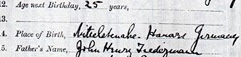
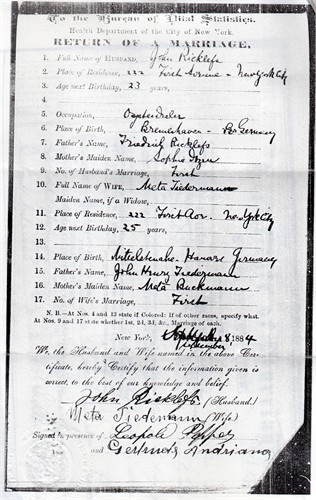
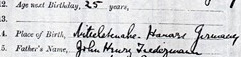
Any of you who are regular readers of this blog will know that I recently put out a call for help in deciphering the handwriting on the marriage certificate for my third great grandmother, Meta Tiedemann Ricklefs, where her hometown was listed. If you recall, it looked a little something like this:


After careful consideration, I settled on the beginning of the word being "Mittels" and the end of the word being "ohe" or "ahe." The middle was a mystery, and I couldn't find anything even remotely similar to the spelling of this word anywhere near Hanover. So as I do when I get frustrated, I put it asided and moved on to something else. Well, during one of our breaks at the conference, Cousin April and I started wandering around the exhibition hall. She stopped to look at some books at one vendor and I noticed that on one shelf were books that listed place names in specific regions in Germany. On a whim, I picked up Hanover and started flipping through. And wouldn't you know it, there it was.

Mittelstenahe

Actually, I knew that was it before I could even picture in my head how it was spelled on the marriage certificate - had there been a "t" in it? Was I imagining things? I used my handy-dandy Android phone to pull up the image I had posted on Ancestry, pulled April over to have her be my second set of eyes, and there it was, plain as day and so obvious I couldn't believe I couldn't figure it out before. I used another book on German parishes at that same vendor to look up where this town might have been located in Hanover and it was listed in there, too, located in southern Hanover in the Protestant parish of Lamstedt. This jived with other records I had seen and suspected were related to my Meta but which I was certain were about her. A quick Google search also showed me that this town still exists; you can see it on Google maps.

So now I have a civil region to look for records in as well as a church parish region to look for records in - all because April stopped at one of many book vendors at this thing and I got bored and decided to look up the first thing that popped into my head. It was amazing and a total "a-ha!" moment for me this past week. That feeling of wonder and discovery and of putting together the pieces of a puzzle and of success, that's just one of the best things about doing this - I didn't know how I was ever going to solve that. It was just so exciting and opens a new door for me to continue through on tracing that line.

So, one mystery down, a million more to go! :)

National Genealogical Society family history conference Charleston 2011: an overview of a first-timer's experience

Going to this conference was pretty much what I expected. The grand scale of it was what I didn't expect. There were 1,700 participants from all across the country, and when you counted volunteers and exhibitors, that number rose to about 2,000 people at this thing, which was held at the Charleston Area Convention Center. Workshops started at 8 in the morning and ran for about an hour each. Classes ended by 5, but then there were social activities which were both an opportunity to network, socialize with other family historians (the only people you can talk to about this stuff who are sincere when they say it all sounds so interesting! :)) as well as experience a little bit of the city of Charleston and its culture. In between lectures you could visit the exhibit hall, where there were all sorts of vendors - historical and/or genealogical societies, genealogy websites, genealogy software companies, photo restorers, book vendors, scanner companies, genealogy classes, DNA companies, anybody or anything with even a tangential relation to family history research. It really hit home for me from the exhibit hall just how intertwined technology and genealogy have become and are continuing to become, and while I hate how easy the Internet has made it to do shoddy genealogy, it was refreshing and reassuring to see how committed websites such as Ancestry, FamilySearch and Archives are to making it easier to do reliable and good genealogy.

Buzzy Jackson, author of "Shaking the Family Tree" gave a nice keynote talk about how her interest in genealogy was piqued and her family history journey, and David Ferriero, the archivist at the National Archives, also gave a nice talk about the work they're doing (less than a year to go until the 1940 U.S. census becomes public!!). I took classes on specific topics like using city directories and obituaries in conjunction with the census to locate family, the types of Irish land valuation records that are available besides Griffith's, how church records are so important to tracing your German heritage, how to read probate records. I took more general ones on the importance of historical context to telling your ancestors' full story, using siblings and/or associates to try to work backward when you hit a brick wall with a particular ancestor, why and how to narrow your focus when planning field research, how to go about resolving conflicting evidence.

We got to wander the Charleston Museum, the oldest museum in the country, after hours, which was kind of cool and not at all scary (I kept thinking of that Ben Stiller movie Night at the Museum, where all the displays come alive after dark - nothing like that here)! We ate barbecue at the Charleston Rifle Club (weaponry not included), hosted by the South Carolina Genealogical Society. We attended a luncheon hosted by the New England Historic Genealogical Society (as seen on "Who Do You Think You Are?") and learned more about them and the work they do and Cousin April and I were both convinced that because of our New York and New England family history, it would be beneficial to join.

We met people from all over the country - even as a genealogist it was kind of crazy to see just how many people take this hobby seriously (is it still a hobby then? Who knows...) The majority of people were seniors - I guess there's more time for this stuff in retirement, but there were more people in their 40s and 30s than I anticipated. One of the most interesting people I met was Candace, a fifth generation Montanan, who now works at FamilySearch in Utah. She was intrigued to hear Cousin April and I are from the Hempstead area of Long Island because she was in Hempstead last year researching her colonial Long Island roots at, of all places, St. George's Episcopal Church, which is where many people in my tree were baptized and married. She didn't appear to be related to us, but her family, the Lotts and the Hewletts, are both names that I recognize and come across all the time. It's just funny to realize how small the world can really be, and I think genealogy magnifies that a lot.

The whole week was an amazing experience. Definitely the location was part of the draw, but the chance to network and learn from genealogists with so much more experience and so many more credentials than myself was awesome - being in that environment was a real shot in the arm, rejuvenating my family history research spirit. I don't know that the classes change often enough that I would go to this thing every year, but technology changes so quickly and new records and resources are coming to light every day that I would definitely consider doing this again in the future. Maybe I'll see y'all there! (My boyfriend says that yes, the Southern accent is there. For real.)

:)

All good things must come to an end...

So, unfortunately, I'm back in New York. I had hoped to post more than the lame once that I did while I was still in South Carolina but any of you who have ever been to this family history conference already knew what I learned this past week - I was up by six each day, in workshops by eight, and busy with activities until 10 at night. By the time I got back to the hotel, I was plumb tuckered out (the Southern accent and lingo is lingering, y'all!) And then on Thursday I actually had an hour before bed to write some stuff...and Blogger was down.

Ah, the universe.

Anyway, I actually can't write much right now either, but I wanted to let everyone know that the National Genealogical Society's family history conference was an amazing experience - I learned some new resources and research methods, met some great people (including a woman who works for FamilySearch out in Utah who had been to Hempstead last summer, including my St. George's Episcopal Church, to research her own family tree - small world!), got to see the church my family worshipped at in the early 1700s, made use of the local history room at the Charleston Public Library, had my genealogy battery recharged, and even solved my Meta Tiedemann Ricklefs hometown riddle!

So, fingers crossed, I should be posting a bunch of different entries over the next week or so going into more detail. In the mean time, I was able to tweet throughout the conference, so if you're looking for a taste of what it was like or to read something that's a little bit more real-time of the experience, you can read up on my Twitter name, @marygenealogy79. There's a scroll on the front of this blog or you can just go to Twitter. Can't wait to share more with yous (oh no, the New Yorker in me is back! lol) later!

Getting to know Charleston, South Carolina and some little known southern roots ahead of the national genealogy conference

Writing from Charleston, y'all!

Yes, I'm speaking with a Southern accent. I've only been here 24 hours. That's how I roll.

Cousin April and I left at 4 in the morning yesterday (that's Monday May 9th for anyone who, like myself, is easily confused)...we stopped for lunch in Hopewell, Virginia just southeast of Richmond where a distant relation of hers and an even more distant relation of mine, a Civil War veteran, is buried. We made it to Charleston in 15 hours, which is great time but a looong one-day trip. Since it was still light out (yay, daylights savings!) we drove around the historic section on the waterfront a bit before stopping for dinner. Charleston waterfront? Gorgeous. Old-school Charleston architecture? Everything you picture when you picture the Deep South. This is definitely where Rhett Butler came from.

So, the genealogy conference doesn't actually start until tomorrow. Today were some optional seminars and trips, and April went to one at the Charleston Public Library and I had signed up for a trip to the state archives in Columbia. I love archives, but I didn't go.

Here's the thing about Charleston. The city is architecturally and even culturally beautiful, as I knew it would be. I've been to South Carolina before but this was my first time in this city. I've been wanting to come here for awhile but not to see any museum or historic landmark or whatnot. I feel a connection to Charleston.

I don't feel connected to any American cities. My family came to America for the most part, landed in New York and said, "That's it. I'm done. That's as American as I get." All my American ancestry is in the New York metro area. Yes, I have New England ancestry too, but most people with colonial ancestry do. That's been well-documented and as a New Yorker you learn about it and travel there - there's nothing new to learn about it. But this deep-rooted American New Yorker has some Deep South roots, and those roots grew here in Charleston.

It's late and we have to be up early to check-in and begin a day of workshops tomorrow, so I'll end it there for now, but I'll update you later this week on both my experience at and review of the conference as well as share with you about my Story family and Ellis family and getting to know them a little better as well as a little more about this place they called home for three generations in the late 17th and early 18th century.

G'night, y'all! :)

T-minus one week until the NGS family history conference in Charleston, South Carolina

It seems like I signed up for this event years ago, but in one week, cousin April and I will be in Charleston, South Carolina for the National Geneological Society's annual family history conference. My co-workers have been very nice about it - I'm sure for anyone who isn't into geneaology, the thought of spending a whole week stuck in workshops and lectures all day long sounds like torture and the worst reason to take off work. But they all know how much I love genealogy so they're actually excited for me.

I'm excited about seeing a little bit of Charleston - I love the South and Charleston has always sounded charming. Add in the 150th anniversary of the Civil War this year, which began in Charleston, and the fact that I have family who lived in that city about 100 years before that, and I'm looking forward to getting to know the place a little bit.

But mostly, now it's crunch time. The packing list has been started, plans with April have been set, and now I have to look at the actual reason I'm going there - genealogy. What information do I have that I'd like to share? What information do I need? What research methods and resources am I most interested in learning about? Which of those are most crucial to my own research to learn? Which workshops in which timeslots will give me the most bang for my buck - be helpful to my personal family history/be helpful in learning how to help others with their research and making sure I don't sign up for a German research class for example in every single timeslot - got to make sure I spread it out! I'm also excited to spend time with people from all over who are as passionate about this subject as I am!

I'm planning on bringing my laptop to the conference with me, so for any of y'all who won't be there, hopefully I'll have time at the end of the day to share some of what I'm experiencing and learning while there, and if anyone is going to be attending, well then I look forward to seeing you there! :)

Fun with names: Whitehead Raynor

I promise this will be the last in the name series for a while. For a little bit, anyway... :)

So, my fifth great-grandfather's name was Whitehead Raynor and his is a name that has always intrigued me. As a kid and then as a teenager, the name "Whitehead" obviously conjures some unpleasant skin-related images and you wonder just what in the heck Whitehead's parents were thinking. Whitehead is not one of those old-fashioned names that randomly pop up or become popular again. And probably with good reason.

As it turns out, though, as I was scrolling through all the baptismal records and marriage records that were transcribed from St. George's Episcopal Church in Hempstead, New York from the 1700s and 1800s, Whitehead is a name that appears - well, to say frequently might be an overstatement, but let's just say that there were enough of them that in school, my Whitehead might have to have been known as Whitehead R. to distinguish him from the others. It turns out that Whitehead, like Raynor and Smith and Bedell and Pearsall, is a Hempstead family name. Unfortunately, if I can't connect my tree to a family, I usually don't pay that much attention to it - family history tunnel vision? But yes, Daniel Whitehead in fact was one of the original 50 proprietors of Hempstead in the 1640s.

So what does that mean for Whitehead Raynor? In Hempstead, as in other places, unusual first names turn up that turn out to be a surname from the same area - a mother or a grandmother's maiden name in many cases. But as I mentioned above, I don't have any Whiteheads in my family. Or do I? There are branches on my tree, maternal lines, that I can't trace. The mother is a dead end. Is it possible that along one of these lines I have a connection to the Whitehead family? Or maybe Whitehead's parents wanted to honor a friend who was a Whitehead or a Whitehead who married into the family through a sibling or a cousin - is that a naming practice that might have occurred? These are the questions I ask myself when I go back over these lines.

And then I guess it's entirely possible that Whitehead's parents just thought it was a cool or hip name in which case all I can do is hang and shake my head and add it to my list of things to ask my ancestors, when I die, "What in the heck were you thinking?"

;)

Fun with names addendum: Freelove (Freeway)

Let's just get this out of the way at the start - this post is not about genealogy.

Ok, anyone who's a fan of the U.K. series The Office will know where I'm going with this. As I mentioned in my last post, Freelove was a somewhat popular name for baby girls in 17th & 18th century Hempstead on Long Island. If only those poor, Puritanical settlers only knew how prescient and ahead of the times they were giving their daughters such a hippie name (I mean, really, Freelove? That girl's going to grow up to be a flower child, whether its the 1760s or the 1960s...)

Anyway, besides the nice ring the name has to it, I couldn't figure out why I was so drawn to it, until I caught myself humming a little ditty over the last day or so. Couldn't get it out of my head. Realized I had stuck in my head an original piece by David Brent, the alter ego of Ricky Gervais from The Office. The song is hilarious within the context of the episode that featured it, but even without that context, it's just catchy. And so I won't be the only loony tune walking around singin' this thing, and because now besides always making me laugh this song will always make me think of genealogy (oh, word association!), I thought I'd share. There's some talking at the beginning - I would skip to about the one minute mark. Enjoy!


Fun with names. Again. :)

I am fascinated by names - where they come from, how people choose them, naming trends, naming patterns, you name it, I'm obsessed.

Usually, the first thing we learn about a newly discovered ancestor is his or her name. A name can tell you a lot about a person - where they came from, possible family names to keep an eye out for. They can even tell you things that have nothing to do with genealogy but everything to do with what kind of person someone was - were his or her parents traditional or creative, close to a family member they wanted to honor or hoping their child would be independent.

As you can see, I think a lot about this stuff.

Anyway, in looking more closely at my American family history, I've been going through old church records of marriages and christenings from St. George's Episcopal Church in Hempstead on Long Island, and it's mostly full of your traditional English Marys and Josephs and Margarets and Thomases. But every now and then you run into a Pamela or a Gloriana, something a little more fanciful and exciting. (This is coming from a Mary who loves her traditional name.)

My favorite part, though, are the Puritan-reminiscent names. Everybody's heard of them - the parents who named their daughters Mercy or Charity or Hope or Faith in the hopes that their daughters would embody those qualities. That's the way the original English settlers in America named - they wanted those virtues to be in your face. So it's never a surprise for me to come across them in my research (although I'm fairly disappointed that on my own lines, no one was apparently religious or Puritanical enough to bestow said names on any of my ancestors). You also get your Old Testament fare. I mean the Jacobs and the Samuels, but I also mean the Enochs and the Josephats, as if these people wanted to be biblical but also creative. Either that or they just hated their children. I definitely have some OT names on my tree.

So as I was going through these transcribed records, I thought I'd share some of my favorite biblical and Pilgrim-esque names that I've been coming across, that it'll be a good laugh for a Monday, but also a reminder of the different times these people lived in.

(All of these come from the book "Adventures for God: A history of St. George's Episcopal Church" by John Sylvanus Haight, New York, 1932):

Lemuel Ackley, son of Abijah Ackley (you'd think after having been given the name Abijah by his parents, ole' Abijah wouldn't have tortured his own offspring in the same manner - he also had a son Abijah...)

Elnathan Eldert - at least he learned from his own unfortunate name and named his kids Sarah, Robert, and James

Freelove Nicols, wife of Jacob - you'd be surprised how popular Freelove was in 16th and 17th century Hempstead. The name, not the person. Well, maybe also the person.

Uriah - that was a popular biblical name making the rounds of Hempstead...

Comfort Rhodes

Nehemiah Sammis, son of Benjamin and Abigail - they probably thought "How come we got the same ole' boring biblical names everyone else in this town got? Let's open our Bible to whatever page, point, and whatever we're pointing at, that's what we'll name our son!"

Sylvanus - I'm actually not sure where this name comes from, but it turns up a lot...

Parmenus Smith, son of Mordecai - 'nuff said

Abraham Wood, son of Epenetus - that's an example of a father learning from his parents' mistake...

Elijah Wood - that's not weird, that's just a name of a current Hollywood actor that turns up a lot in these old records... :)

Flower Hulse - unfortunately this is for real and even worse, it's a guy. It's a family name, but really, if your wife's maiden name is Flower, just go with John. Sometimes boring and the same as everyone else is okay.

Eliphilet Stratton

Divine, son of John and Sarah Hewlett - I don't know if they had drag queens back then, but if you name your daughter that, you're asking for her to grow up to be a stripper. If you name your son that, drag queen. Or you're just really religious and oblivious.

Jacamiah Allen - that's not too bad. You can go by the nickname "Jack."

Gebulon, son of Robert Pedrick

Lerujah, daughter of Daniel and Sarah Vine

Temperence Beedle - that's a good early New England name!

Freeman Place - the male version of Freelove?

Patience Cornelius

Anyway, that's just to name a few. If I shouted out any of your ancestors - it's all good-natured jesting, I assure you! Like I said, it was a different time. Believe you me, I guarantee our descendants are going to have an absolute field day when they look back at this time and place! :)

End of the weekend musings

I went through "Who Do You Think You Are?" withdrawal this week...anybody else? Fortunately, "Friday Night Lights" filled the vacated WDYTYA timeslot and allowed me to continue my crying streak uninterrupted, lol...

I was covering a lecture by Cardinal Edward Egan for work this weekend on one of the Gospel stories, and the he was going in-depth about some of the customs and actions portrayed that are totally foreign to a 21st century New Yorker, and the explanation really helped clarify what was actually happening in the story and the significance of them, and I couldn't help but compare it to genealogy (doesn't everything come back to genealogy? :)) and how important it is to try to get as much information as possible about the times and places our ancestors lived to get a better understanding of the motivations that might have been behind the choices they made and the things they did...I think we all try to do that, though.

I also wanted to note how the Ashley Judd episode of WDYTYA really made me refocus on my old American lines - my family has been here for so long on my mom's side of the family that I don't always feel comfortable saying I'm English and Dutch. On those lines, I just feel "American." Anyway, I have old New York ancestry, I have old New England ancestry, I have a lot of Quaker ancestry that I've never really delved into - once you reach a point in your family history that there are just branches and branches to trace, you have to pick and choose what to focus on when, and sometimes it takes awhile to come back and refocus on a particular line. So I think I'd like to learn more about my Quaker family and some of my "American" lines for a bit.

150 years ago today...remembering the start of the American Civil War

150 years ago today, Confederate soldiers fired on Fort Sumter in Charleston, South Carolina, marking the start of a pivotal part of American history. Whatever the reasons the Civil War was fought on a national scale - the abolition of slavery, states' rights - or a personal scale - pride, loyalty, a way of life, money - those four years changed the face and future of the country. Between 600,000-700,000 soldiers were killed, affecting not only families of the time but those of us here today!

Here is a link to the Fort Sumter National Monument website for the anniversary:

http://www.nps.gov/fosu/parknews/civil-war-sesquicentennial.htm

Today I remember my Civil War veteran ancestor, Charles Haase, a German immigrant who left his wife and baby daughter to fight with the New Jersey Infantry 33rd regiment, company H - he mustered in at Trenton, New Jersey on 22 September 1864 and was discharged at Bladensburg, Maryland on June 1, 1865. I also remember all the other soldiers - those who made it home as well as those who did not, all their families, and all their descendants who keep their memories alive as family historians!

Musings on the Ashley Judd episode of "Who Do You Think You Are?"

  • I get excited when I see how excited other people get by the information they uncover. It's like letting the rest of the world in on the secret that yeah, genealogy is pretty cool.
  • When I watch this show I sometimes feel like everybody uncovers such cool and interesting family histories and the things they find out make my own history seem so boring, but I think that's just that the "new" is always exciting - I've known most of my family history for years so it's lost some of its shiny-ness, but I remember what it felt like to first learn those things and I know how I feel now by the new things I discover.
  • It's interesting to see who people decide to pursue - I think we want to find out more about people we find relatable, people whose stories make us understand ourselves better.
  • I'm so jealous that Ashley Judd has a Mayflower ancestor!! I think all of us who have early New England/Great Migration ancestry get a kick out of the possibility of having a Mayflower relation...my English immigrant ancestors didn't get here until a full 14 years later :( (the Raynors, the ones I know the most about anyway...I'm still holding out hope for a Mayflower connection on one of my so far unpursued female lines! :))
  • I liked that Ashley really got into the story behind her Mayflower ancestor - we all know that the Pilgrims came here for religious freedom but I know very little about the actual stories for the individuals, the real troubles they faced before they fled...
  • Leyden shout-out! As soon as they said Holland, I said to myself "I bet they went to Leyden..." because there was an English population there (including some of my ancestors) seeking religious freedom before coming to America.
  • This episode made me realize the many experts they use to give more of a person's backstory - it's not just genealogists but so many experts in geographical areas, in historical areas...there are so many resources at our fingertips, not just documents but people!
  • I cried when Ashley was learning about her Civil War vet ancestor, Elijah Hensley - what a story. That was pretty cool (and moving) to hear about.

Season finale of "Who Do You Think You Are?" tonight

It's that time of the week again, folks...tonight is the season finale (I'm fairly certain) of the second season of "Who Do You Think You Are?" Ashley Judd is the subject - I've always liked her as an actress, and it looks like this southern girl discovers some deep New England American roots. Should be interesting.

These seasons are so short they just fly by - didn't this season of WDYTYA just start?? What am I going to watch on Saturday afternoons now when I need a break from cleaning my house? Lol... anyone out there who reads this blog who has seen the British original-recipe version of this show, are those eps worth trying to track down to watch? Do they follow any celebrities Americans might be familiar with (I remember glancing at a list once and only recognizing Alan Cumming)? Are the episodes interesting enough that it doesn't matter if I recognize the celebrity? Not only am I worried about WDYTYA withdrawal but I'm curious to note any differences - I think, while the pursuit of genealogy is similar across national and cultural borders, that the resources are sometimes different and the stories are certainly different. In America, we get eclectic background mixes; we get the children of recent immigrants; and we get those who can trace their families back centuries to the first wave of European immigrants. I wonder if, for example, there are many people in England who are the children or grandchildren of immigrants, or if most people's backgrounds are more homogenous. And I don't know much about modern British history - I know it's a big deal here to discover you had an ancestor who fought in the Civil War - is there a British equivalent to that? Is it easier to trace your family further back because there is the possibility of less immigration and emigration going on? These are the things I think about...

Anyway, just a reminder too that next Tuesday is the 150th anniversary of the start of the American Civil War so I'll be posting about that next week and look for my thoughts on tonight's Ashley Judd WDYTYA installment at some point before Monday (hopefully!)

"Who Do You Think You Are?" airs on NBC at 8 pm EST.

Happy weekend everyone!

Wishing Grandma, the original genealogist, a happy birthday!

She is not, of course, the original genealogist EVER (she's not that old!) but my grandmother, Mary Elizabeth Cronin Raynor, is the original genealogist in my family. She was born April 5, 1915 to Timothy Ambrose Cronin and Ellen Marie Casey. She started genealogy as a hobby when she was younger and it just took off from there - she started when there was no Internet to help, when she had to write letters to churches and relatives and state agencies and visit cemeteries and read books and everything else we should still be doing but which has become much easier and accessible (yes, we are a little "spoiled"! :)) But it's because of her that I had so much information to start with on BOTH sides of my family and it's because of her that I was exposed to genealogy at all, that I saw I how fun and interesting it can be. If genealogy is an inherited trait, I got it from her (and since today is her 96th birthday and she's still going strong, I hope I inherited her other genes as well!) - so thank you, Grandma, from one genealogist to another, and a very happy birthday!


My grandma, Mary, and her older brother, Dan. She looks about 3 yrs old so probably about 1918.

Grandma at about 13 with her mom Ellen Casey Cronin


Grandma with her brother, Dan Cronin, to the left
and cousin, Ralph Casey, to the right.


The Casey women - my grandmother (second from left), her mom Ellen Casey Cronin (second from right), and all the Casey aunts (sisters and sister-in-law) at Coney Island.


Grandma and Grandpa at their wedding in 1946.

Grandma, her mom, and my uncle Cliff, about 1949.


The two genealogists and the two Marys :) - Grandma and me, about October 1979.


Belated thoughts on the Gwyneth Paltrow episode of "Who Do You Think You Are?"

It's been a lazy weekend for blogging - sorry for the delay, folks!

  • I think Gwyneth Paltrow's family background is more and more an example of the typical American background - an eclectic mix of countries and religions all coming together in this "melting pot." I'm kind of jealous of the variety she has, from the British from Barbados to the Polish rabbis - I'm proud of my heritage but sometimes I feel like it's your standard, boring old-school American ancestry of half-and-half (although not straight-up half-Irish, half-German, when I explain to people who aren't into genealogy my background, that's how I simplify it.)
  • I enjoyed Gwyneth's Barbados journey, especially when she was speaking to the historian. Not all of us can be experts in every time period we have family members in, but I think that's what we have to try to do if we're interested in the stories behind the names and dates. We might not have letters or documents detailing the motivations for the decisions our family members made, but to use Gwyneth's family as an example, we can look at what was going on in Barbados at the time, what society was like, to try to figure out why an 18 year old girl would have been desperate to leave there and travel to America...my mom had a similar project like that in college, where she was given a name, a birth date and place and a death date and place, and she had to research what was going on in that place at that time to develop a fictional but accurate life story for that person. I always found that fascinating. And that's what we do with our family trees.
  • This episode, unlike the Steve Buscemi episode, epitomized for me how much hand-holding the program does for these celebrities. All Gwyneth did was travel to different locations (Municipal Archives shout-out!) and get folders or books handed to her. If only our research was so simple!
  • I liked that Gwyneth was interested in the stories and motivations of her ancestors - I think she called them "more than names and dates," which is what people sometimes forget. I particularly liked her trying to understand her great-grandmother, the reasons behind why she turned out to not be such a great mother to Paltrow's grandfather. And there were reasons.
  • Paltrow said to her mother, Blythe Danner, how when you go through all the lines and all the generations, you see "echoes," traits and personalities and stories that get repeated from parents to children to grandchildren. In her case, she mentioned children who look up to and love their fathers as well as people who are seeking a deeper spirituality. I also enjoy that part of genealogy - we enjoy finding those who are different and exotic but we also look for ourselves in these family members.
  • She also mentioned how she wished she could have shared what she found out with both her father and grandfather and I think about that, too, all the things I've discovered that I think my mom or my grandparents would have found interesting, that we could've enjoyed learning about together, but I think those who have passed quite possibly may already know these stories from the people who lived them themselves...at least I hope so!

Our weekly WDYTYA reminder and a call for help from my fellow researchers!!!

Let's start by saying that tonight is the Gwyneth Paltrow episode of "Who Do You Think You Are?" I always kind of liked her and her parents, so I'll be interested to see what she's looking for and which lines they follow.

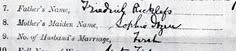
On a personal note, I need some help on several things. Two of them have to do with deciphering handwriting. Handwritten records can always be a tricky thing and after awhile, sometimes you just get locked into one word or you just can't put it together. So I'm asking for a fresh set of eyes to look at these names - one is the maiden name of my fourth great grandmother, Sophie Ricklefs. I won't tell you what every transcription has it as so as not to put a preconceived notion into your heads.

The second is the town in Germany from which my third great grandmother, Meta Tiedemann Ricklefs, hails. For the life of me, I can't tell what it says. But maybe it's a town your family comes from or a name you're familiar with. Maybe all those crazy letters make sense to you or you just need a current puzzle and want to give this one a shot. Both of these are coming from the back page of John Ricklefs and Meta Tiedemann's marriage certificate - any ideas are appreciated!


The third request is not so much a call for help as just putting the information out into the universe - my great-great grandmother Mary Horgan Gorry corresponded with a soldier during World War I named R. Morrow. My father and I think he might have been from New York City and that his first name might have been Robert. He was at the N.C.O. School, Section C Co. E in Camp Greenleaf in Chickamauga, Tennessee in 1918. His letters give a little bit of insight into life at the camp in general and things going on in his life in particular and I just wanted to put out there that if R. Morrow has any family alive today, and any family that might be doing their own family history, that I would love to share his letters with you!

"Who Do You Think You Are?" airs tonight at 8 p.m. EST on NBC - watch it!

Happy weekend everyone!

John Reinhardt death record, Union, Hudson County, New Jersey 1870

I've had this for about six months now, got lazy about uploading it, then misplaced it, and since I've started cleaning house, just recently rediscovered it. I've always been very happy with the service of the New York City Municipal Archives as well as the National Archives, but with my Reinhardt relations having spent a few decades across the river in New Jersey, I've had to use the New Jersey State Archives as well and they have also been extremely helpful. So, two snaps to well organized, well preserved archives!

This is the death record for John Reinhardt, my 5th great-grandfather, the maternal grandfather of my Civil War ancestor Charles Haase. John is one of my immigrant ancestors, and though I don't know specifics about where he came from or what happened to his wife after he died, I now have a little more information on his death. John was also the patriarch of several generations of well-known and influential Reinhardts in the Hudson County, Union/Hoboken/Weehawken area of New Jersey.

So, since the pictures aren't great (the first is the whole record, the second two are the first and second halves of the record taken a little closer), here's what it says (John's is the highlighted name):

It's from Volume AQ, p. 412 from 1 Sept. 1870 - 1 Sept. 1871; town of Union, County of Hudson, State of New Jersey; John Reinhardt died Oct. 17, 1870. He was married, 56 years old, no occupation. Town of death was Union. Place of birth was Germania. No parents listed (boo). Cause of death - atrophy of the brain. Not sure what that means...anyway, it's interesting to see how deaths were recorded before certificates and in different states. Enjoy!