Valentine's Day tribute to my family

Just wanted to post some photos of couples in my tree, who if they had never gotten together, I wouldn't be here today - Happy Valentine's Day everyone!

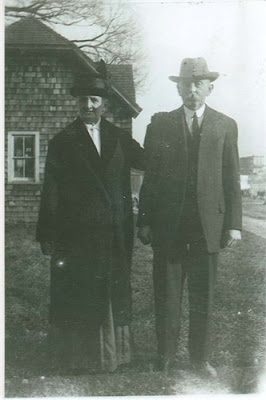
My great-great grandparents, Delia Dauch Berg and Theodore Peterson Berg circa 1930.

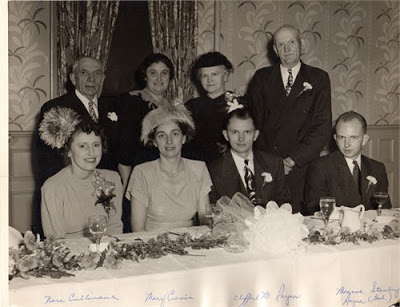
Three couples for the price of one! - my great grandparents (standing from left to right) Timothy Cronin and Ellen Casey Cronin, Amelia Berg Raynor and Monroe Raynor at the 2 Nov 1946 wedding of their kids and my grandparents, Mary Cronin Raynor and Clifford Monroe Raynor (seated middle).

The wedding photo of my great grandparents Timothy Cronin and Ellen Casey Cronin, 15 Oct 1912 (he was 33, she was 19).

My great great grandparents Joseph James "J.J." Raynor and Annie Poole Raynor, circa 1930.

My grandparents, Helen Meta Stutzmann Gorry and Elmer Anthony Gorry, on their wedding day 18 Aug 1951 - look how happy they look and how beautiful my grandmother was!

Some quick thoughts on the second episode of "Who Do You Think You Are?"

  • I didn't cry watching this episode this morning but I definitely teared up, enough so that I had to wipe my eyes, so I'm counting it - the streak continues!
  • Learned something new - I had thought that my German ancestors were here early, coming over to New York about 1840 but apparently there were German immigrants here by 1710, which I did not know. Tim McGraw's ancestor Jost Hite was from the same region of Germany, the Rhineland-Palatinate, as some of my German ancestors. Maybe they knew each other back in the Old Country! :)
  • Got misty eyed when Tim was in the Library of Congress and realized that his ancestor had made an impression on one of Tim's heroes, George Washington, enough so that Washington mentioned them in his journal and in a letter. That's got to be a cool discovery.
  • Liked that Tim wasn't just looking for names, dates, and places - he wanted to know why decisions were made and things happened, the whole story behind an event like someone's early death. That's the way to do this right - you should want to know the whole picture and the whole person your ancestor was.
  • Tim really seemed to identify with his one ancestor Jost Hite and I think we've all been there, the one person in our tree we come across whose story we just have to know, who really makes an impression on us, who we either truly identify with or whose story just truly amazes us.
  • And that point leads me to the other thing I thought about as I was watching Tim McGraw on his journey - that delving into our family histories is about discovering our family stories but it's also about either discovering things about ourselves or seeing something about ourselves in former generations - Tim talked about themes or patterns he was discovering in his ancestors' personalities and I think we all want to find ourselves in our ancestors - we all want to be part of the pattern or part of the theme.
Next week, Rosie O'Donnell. Not a huge fan of hers but am very much looking forward to her story - as someone who lost her mother very young she probably knew very little about that side of her family.

Enjoy your weekends everyone! :)

Reminder: Episode 2 of Who Do You Think You Are? - Tim McGraw

Just a reminder to watch or set your DVR for the second episode of NBC's "Who Do You Think You Are?" tonight. Tonight's episode focuses on country music star Tim McGraw - since he didn't know who his real father was for quite some time, looks like this should be an interesting episode. I'll post my thoughts on the ep sometime this weekend, but for now, I'm taking bets on whether or not y'all think the crying streak will continue tonight! I'm going to try to match last year's perfect season, LOL

NBC at 8 p.m. - watch it, ya heard? :)

Happy birthday, Grandma!

And just because I'm a terrible granddaughter who forgot and my just dad reminded me, I'd like to wish my late grandmother, Helen Stutzmann Gorry, a very happy birthday - she would have been 79 years old today. Grandma, I hope Grandpa is throwing you a great big birthday bash and making you laugh your butt off up in heaven!

Marys, Marys everywhere...the confusion that comes when everyone in your tree has the same name

What do you do when your great grandmother's name is Mary Gorry? And your great-great grandmother's name is Mary Gorry? And your great-great-great grandmother's name is Mary Gorry? (And seriously, in my family, I can go both backward and sideways several times more with that name...) And then what do you do when two of those Marys are married to a James Gorry?

For one, it can be very easy to confuse not only what record belongs to which person, but just who is who to begin with. Now, most families don't suffer this name confusion to the extent that my family does, but everyone has someone in their tree who has the same name or a very similar name to someone else in their tree, in which case it can be very easy to confuse two individuals and get information wrong. My best friend is a firm believer that naming a son a junior is not a good idea, because then bills and records for father and son with identical first, middle, and last names get easily mixed up and sent to the wrong person. So it is with genealogical research.

This can also happen when families have more than one child with the same name - sometimes this happens when a first child dies and the family has another baby to whom they give the same name. Such is what happened with my great great grandmother, Mary Tormey Gorry, who had an older sister Mary who died as an infant before my Mary was born. And then there are families (I know both the Irish and the Germans do this) who have a tradition of giving all the sons or all the daughters the same first name and then calling the child by their middle name.

Anyway, my dad mentioned to me that he came across this multiple Mary-James problem when he first started researching his tree, and I thought it was a great point - check dates, check other records. Discrepencies in information can mean human error in making the record. Or it could mean you've come across two different people with the same name. Pay special attention to this if your family has a tradition of giving the same name over and over again!

Ancestors who want to be found - Catherine Neher Meinberg Hellmann

I have to say, in all my years researching my family tree, no ancestor of mine wants to be found more than my 4th great-grandmother Catherine Neher Meinberg Hellmann. Her spirit seems to be manipulating the universe to open up avenues for me to discover her, moreso than any other person I've had to find entirely from scratch.

A little less than a year ago is when I had my first breakthrough with her, with the discovery of her obit and the fact that the reason I couldn't find her anywhere is that because after her first husband and my 4th great grandfather John Meinberg died, she remarried to a George Hellmann. That oh so tiny but oh so important fact knocked down her brick wall, and I found her in the census, discovered she had at least two sisters, and was able to order both a death certificate and marriage certificate. Those two last items led me to my 5th great grandparents, Martin Neher and Anna Maria Mitsch, who, like every new generation that is revealed, posed yet another brick wall, and so I put aside my Catherine Neher research for the time being. Sometimes you need to refocus, regroup, and then return.

Catherine, though, seems to be an impatient one. I think I might have annoyed her a bit by moving on to my other branches.

On Ancestry, you can build a family tree. It's both a help and a hindrance, because the website automatically searches its records periodically for matches to people in your tree - sometimes the searches are fruitful but more often than not they've just been completely wrong and a source of false hope. What it also does is connect you to other people who are researching the same people in their trees - again, this is both a good and a bad thing. Obviously, I am a huge proponent of sharing your research, and I am happy for people to have access to the records I have acquired. It's when I am doing my own research that I am either a) told to connect to someone who is sharing wrong, unsourced info or b) people whose sources are my own, with no new ones to offer that this feature isn't my favorite.

Anyway, recently someone has been copying my sources and records for Catherine to their own tree. Fantastic. Apparently they are following the lines of one of her sisters, Elizabeth Neher Riders. I don't primarily work on side branches, but I try to update them when all my backroads are blocked. Plus, knowing the side branches gives you other names to search for, as someone might not have your ancestor on their tree, but they might be descended from a sibling and have information on his or her parents that you don't have. So it's important to trace those side lines.

And how.

Something moved me today to check this person's actual tree, instead of just looking at the notifications of what they were taking from me. Catherine was giving me a little nudge, I suppose. Attached to my Catherine, Martin, and Anna Maria in his tree were handwritten notes on the Neher family by this person's relative - names and dates and how people were related and married names and ship names and birthplaces and I'm just so excited that I can't even stand it. The photos of these notes also shows two other people have connected these records to their trees, so those are other relatives of mine out there.

Since Catherine is being pushy today, I'm going to read these notes more closely in a bit, and will be let you know more when I get a chance!

A little bit persistence, a little bit serendipity...

Matrilineal Monday - Mary Donnelly Corr

I'd like to introduce you to my fourth-great grandmother, Mary Donnelly Corr, of County Cavan, Ireland. Two years ago I didn't know a lick about her. But through some persistence and a little bit o' luck (the usual suspects), I know a lot more about this woman than I ever dreamed.

It starts with her daughter, Mary Corr Gorry, who was married to James Gorry. I knew she was a Mary but I didn't know her maiden name until I ordered a copy of her death certificate from July 1901 in New York City - her parents' first names were unknown, but her father's name was listed as "Mr. Corr." Being the Nancy Drew-in-training that I am, a lightbulb immediately went off in my head. Here was my first connection to the obit for Catherine Corr that my dad had found in his father's basement. I don't believe in coincidences, so my Mary and this Catherine had to be related. Catherine was the daughter of the late Thomas, and judging from the date of things, it appeared that my Mary, born between 1830-1835 and Catherine's father Thomas, were sister and brother.

Off to Ancestry! A search for "Mary Corr" born circa 1832 in Ireland turned up a passenger list manifest from May 7, 1846 for the Macedonia into New York harbor with a Mary Corr, age 17, a Thomas Corr, age 20, a Philipp Corr, age 26, and a Mary D. Corr, age 45, all from County Cavan, Ireland. No family relations were included but I made the assumption that Mary D. Corr had traveled to America with her three children - Philip, Thomas, and Mary. I now had my Corr line, only recently even unknown, back a generation, and to a specific county in Ireland as well.

Which brings us to Mary D. Corr. Luckily, "Philip Corr" is a fairly unusual name, so an Ancestry search for him turned up a hit in the 1850 census, where Philip "Carr" is living with his new wife Bridget, their infant son Thomas, and a Mary Donelly.

Now, we always try to verify and prove everything. But sometimes in order to find those connections that lead us to the proofs, we have to make assumptions - not wild assumptions. More like educated guesses. So this was my educated guess - that this was indeed my Philip and Mary, and that the "D" in "Mary D. Corr" was for Donelly, possibly her maiden name. Why she was using it or recorded as such in the census, I don't know, but it was another clue.

From there, I had my first experience using the New York Emigrants Savings Bank database, which if you can find the right kind of entry, has a wealth of information in it. Luckily for me (and believe me, I don't usually have this kind of luck, finding things so easily, when I do my research) both Thomas and Philip had accounts at that bank, and cross-referencing their entries helped to verify a lot of the information. In an entry for Philip from 8 July 1856, we have Philip Corr, a cartman living at the corner of 5th Street and 14th Avenue, a native of Dungimmon, County Cavan (so now we have a *town* too - excitement!) who arrived May 7, 1846 on the Macedonia. Father, Thomas, is dead. Mother is Mary Donelly. An entry for Thomas Corr from July 1857 lists him as a cartman living on the corner of 5th St. and First Avenue. He was a native of Dungimmon, County Cavan (check), arrived May 7, 1846 on the Macedonia (check). Father, Thomas, dead (check); mother, Mary Donnelly, in New York (check). Married to Bridget Baxter, 3 children. Thomas Corr and Bridget Baxter were the parents of Catherine Corr, of obit fame.

So a hello, too, to Mary Donelly's husband, Thomas Corr. I haven't been able to find Mary in any other census and I have no idea when she died; I don't know a thing about her husband except that he died in Ireland before 1846 and I know nothing of her life there. But by now, I had a wealth of information about her, starting with the simple fact of her existence and a name to put instead of "Mary Corr Gorry's mother," and almost all from records not her own, as our matrilineal research often works. I also had to follow a convoluted path from her daughter Mary to her granddaughter and Mary's niece Catherine to her son and Catherine's father Thomas to her other son Philip in order to find her.

The moral of the story is - look everyone! Everyone can be found. Unless, like some of my ancestors, they apparently don't *want* to be found. But that's a story for another day...

A few quick thoughts about last night's "Who Do You Think You Are?" episode

* Long Island shout-out! Vanessa Williams' father was from Oyster Bay, about a 25 minute drive from me. That whole area is dotted with tiny, old cemeteries like the one her father is buried in.

* Didn't cry for the first 20 minutes or so but did finally break down, so my record remains intact...awesome!

* The National Archives, where she went for her great great grandfather's Civil War records, is where I went for my 4th great grandfather Charles Haase's Civil War records - they are a great resource for military records. Vanessa Williams was lucky to find so much information in her relative's file.

* It was interesting to see how each generation of her family was integrated white, African-American, mulatto. It was have been hard for them in post-Civil War America and early 20th century America but it was interesting to see that being color-blind was a sensibility passed down through the family.

* Watching this show again reiterated for me the need to do more field trips and field work...I do some, like visiting cemeteries, but I don't do enough non-computer based research, which I think means I'm missing some research opportunities.

* It also reiterated that when I need help, I should ask for help. If I don't know the answer, someone else might. For example - now that I have a date and place of death for my 3rd great grandfather John Ricklefs, why haven't I gone to the Patchogue village or Brookhaven town clerk/historian/archivist to get a copy of his death certificate and find where he's buried?

* I think I really lost it in this episode when Vanessa was saying how researching her father's family made her feel close to her father, how reading the story of one of her ancestors was like reading a story about her father, that they both stood for the same things and were the same kind of man. I think that's absolutely one of the best parts of genealogy, is how it can bring us closer to not only our ancestors but our immediate loved ones, those who are still here and those who are gone.

* Love that in the end she did the second most important thing you can do besides researching your family tree - pass it on to your family, most notably the next generation!!

So, so glad this show is back! :)

Reminder - Second season premiere of NBC's "Who Do You Think You Are?"

For anyone who was a fan of the first season of this show, the second season premieres tonight at 8 p.m. on NBC - I believe Vanessa Williams is the subject of the first episode.

I loved the first season of this show. I don't think I learned anything new about how to better do genealogy research but I loved watching other people travel down the roads I've already traveled and the emotions that came with it - the excitement, the frustration, the sadness, the feeling of discovering a little bit more about who you are and the feeling of getting to know and getting close to your family who came before. This show follows celebrities but I think their stories are our stories, whether we're famous or not. We can all relate to the wonder of the genealogy journey.

I'm not ashamed to admit that I think I cried at some point during every single one of last season's six episodes. And every single episode pumped me up to continue my own genealogy journey.

NBC, 8 p.m., "Who Do You Think You Are?" - watch it!

Genealogy website review and round-up - Ancestry, Footnote, World Vital Records, Familysearch

I am currently in the middle of getting all my finances in order. I've spent the past few years being less than fiscally responsible and splurging on things I want but don't necessarily need - a new Coach bag, all my favorite tv shows on dvd, a full Ancestry.com subscription...

I love Ancestry (http://www.ancestry.com/). It has made available, right at our fingertips, so many primary documents that otherwise would have been difficult if not impossible for us to find. That website has been instrumental in the verification and expansion of my tree. It has also cost me a pretty penny. So this past week, I decided to shop around.

I don't like to shop around. Even in real life when I go shopping I don't like to shop around. I find something I like, something I'm comfortable with, and I stick with it. That's my m.o. But Ancestry was costing me $32 a month. That's almost $400 a year. And while the site was invaluable in the beginning and middle stages of my research, lately it hasn't been that helpful with finding new information. So I decided to see if I could find something cheaper.

First I tried Footnote (http://www.footnote.com/). It was advertised on Ancestry. A lot of these websites are either affiliated with each other or have some kind of association, so they help each other out. Most of them will offer at least a 7-day free trial (I started my Ancestry membership almost 10 years ago with a 2-week free trial). Footnote was interesting, because it has documents, many from the National Archives, that Ancestry does not have, so I can see it being a good companion website to Ancestry, but at the same time, their records seemed very specialized - military records, Native American records, FBI records - which is great if that's what you're looking for, but it was not what I was looking for. So I cancelled that.

Then I decided to do a Google search of "best genealogy websites" and I found something called World Vital Records (http://www.worldvitalrecords.com/). It's by the same people who started Ancestry and has many of the same records available, such as some of the U.S. Census records and a huge newspaper collection, but doesn't have quite as an extensive collection of records. At $10 a month, though, a membership to World Vital Records is much more affordable than Ancestry and might be a good place to start if you're not sure what you're looking for yet. Also, just to note, I wasn't really a fan of either sites' search engine and whereas it was easy to cancel my Footnote free trial online, World Vital Records made it more difficult in that I had to call up. That could make it easy to let the free trial end date pass and get stuck paying, but the customer service rep I spoke with was very nice and very helpful.

I don't know if trying two new websites qualifies as "shopping around" but after almost two weeks I decided to stick with Ancestry and downgrade from the monthly world deluxe membership to the monthly U.S. deluxe membership - it's about $10 cheaper and I was using mostly U.S. records anyway. Despite the cost, I really like Ancestry, and if I decide to change my mind again in the future, it's really easy to upgrade to another membership. Also, they are constantly adding new records, so even though I haven't found anything lately, I can't rule out finding pertinent info in the future (1940 U.S. census coming out in 2012 anyone? :))

And on a sidenote, if you don't feel like paying for a website subscription, the LDS Familysearch website (http://www.familysearch.org/) is free and pretty decent. They recently overhauled it, so the search engine is new, but they have a ton of records you can't even find on Ancestry - that's where I found the 1892 and 1905 New York State censuses as well as Kings County probate files for some of my family members. A lot of their databases aren't indexed but if you have the time and patience to go through each record (and believe me, that's what I had to do with Ancestry's census images, line by line, before they were indexed), there are records from all over the world - including Latin America, which Ancestry is not so great with record-wise - with family history nuggets just waiting to be found!

Tombstone Tuesday - Elizabeth Oakes Smith

Elizabeth Oakes Smith headstone in Lakeview Cemetery, Patchogue, New York. Photo by Mary Ellen Gorry 30 June 2009.

I was wandering around Lakeview Cemetery in Patchogue, New York in June 2009, looking headstone by headstone to see if my Ricklefs family, who moved from the city to a farm there in the 1920s, were possibly buried there. At that time, I didn't have a date of death for either John or Meta and so had no death certificate, where you can usually find a place of burial. But I did have an afternoon to kill, so I drove out there and walked around for a couple of hours. I came home with no more info on them, but with a killer sunburn.

Anyway, I like to look at names as I cemetery-wander, and taking photos of names and headstones that interest me, and I came across this - a woman named Elizabeth Oakes Smith, "a lecturer, reformer, and poetess," a "woman of vision and of courage." I had never heard of her, but apparently at the time of her death she was quite important, at least locally so, so this being the 21st century and all, I googled her as soon as I got home, and guess what? I got some hits.

She was born in Maine in 1806 and between the 1830s and 1880s she seems to have been a somewhat well-known feminist writer. She was married to magazine editor and humorist Seba Smith, had six sons, and continued to write across many genres and many forms of media, but most passionately about women's rights.

She and Seba moved to New York City in 1838. In 1859, they retired to rural Patchogue, much as my Ricklefs would 65 years later. She died in 1893.

Matrilineal Monday - Julia Murphy Horgan

I had a hard time deciding who to write about in this blog post. Looking at the women in my tree, I realized that I had a ton of information on some of them (pretty thoroughly researched), no information on some of them (currently very well-built brick walls), but very few who I had only a little information on, but enough clues to work with and try to find out more. A lot of my women have very interesting stories, a lot I am desperately still trying to find their stories and have no idea where to begin, and many of them I've written about in other posts. I finally decided on my third great grandmother, Julia Murphy Horgan, because I can share some of what I've already found out but also share some of the avenues I'm continuing to pursue to find out more.

Much of the information I have on Julia is thanks to the records I have on her daughter Mary Horgan Gorry, my great-great grandmother. Thanks to my pack-rat father and grandfather, we have a ton of original documentation for Mary. According to her death certificate, her parents were John Horgan and Unknown Murphy. Mary's certificate of marriage to James Gorry from her church, Immaculate Conception, does not list her parents' names, but a government-issued marriage certificate usually will - I don't have one for Mary. I do have a record of her baptism, though, also from Immaculate Conception - the record is from 1932, stating Mary was baptized in 1873 and that her parents were John Horgan and Julia Murphy.

Now, I also have an obituary for John Horgan from 1908 in which he is listed as the "beloved husband of the late Julia Murphy."

I have found, with the matrilineal lines, that you often don't have records for the woman herself. But as you can see, you can use documents from other people to prove a person's information. So, all three of those records help verify that her name was in fact Julia Murphy and John Horgan's obituary also proves that by 1908, Julia had already died. In fact, I also have John Horgan listed in the 1905 New York State census as a widower, so Julia had to have died before 1905.

Now, I have no census records for John and Julia, which is very frustrating and a tad annoying. But what I was able to find was a passenger list manifest with their names on it - contemporary to my John and Julia Horgan was another couple named John and Julia Horgan also living in New York City. It has been confusing in my research. Luckily, my John and Julia were different ages then the other John and Julia, and that has helped. Because of that, I am 95 percent certain the John and Julia Horgan on the passenger list manifest are mine (I used John's death certificate and the 1905 New York state census to ascertain John's birth year, which seems to be pretty reliably somewhere around 1841, 1842).

Okay, so the passenger list manifest is for the ship "City of Paris," which sailed out of Liverpool and Queenstown, England and arrived in New York harbor on June 2, 1872. On the first page is a farmer by the name of John Horgan, age 30, and his wife, Julia, age 20, both from Ireland. This arrival date of 1872 jives with Mary Horgan's birth in New York City the following year and John Horgan's age of 30 jives with a birth year of about 1841, 1842. So based on this evidence, I've learned two more facts about Julia Murphy - that she was born about 1852, probably in Ireland, and that she and John were already married before they arrived in New York, so she was probably married in Ireland.

As of right now, that is all I know of her. It's actually quite a lot, I suppose, but I have a lot more questions that are proving to be more difficult to answer than I would have thought. First and foremost is Julia's death - because I can't find her in any census, I have a window of 32 years in which she might have died, from the time her daughter Mary was born in 1873 until the 1905 New York State census, where John Horgan is listed without her. As far as I can tell, Mary Horgan was an only child, so I can't even use any sibling lines to try to find out more about Julia. I could make a trip to the New York City municipal archives to look for a death certificate for Julia, but it would be a tedious and painstaking process without some means of narrowing that window. A death certificate is potentially a goldmine of information - it could list her parents names, and thus get me one step further back on her line; it could list her address at her time of death, which could help me in finding her and John in a census; it could list a place of birth, etc. etc.

Another avenue I could pursue is to try to find a marriage certificate in Ireland for John and Julia - that window is potentially much smaller but I don't have much experience looking for records outside of the United States. I also wouldn't know exactly where to look. I know John was from the city of Cork, but that doesn't mean that's where he was living when he and Julia got married.

In any case, John and Mary have been extremely helpful in getting to know Julia, but Julia's origins, for now anyway, remain a mystery.

A quick comments note and "thank you"

Wha? Rereading this post title, there's got to be a better way to phrase that...oh welI. At least it flows nicely, even if it makes me sound like an illiterate.

I just want to take a second to thank all of you who not only take the time to read my blog but who also take the time to comment on my posts - I really appreciate it and I love reading all the thoughts and insights you share with me through them. I don't respond to every single comment, but I do try to respond to a lot of them, especially if I feel we're getting a conversation started, so please check back when you leave a comment to see if I've responded and feel free to continue to add to the conversation!

Hope everyone enjoys the rest of their weekend, and for all of you in the path of the next huge snowstorm scheduled to hit this week, stay safe, stay warm, and any snow days we might get are great days to catch up on our research! :)

From Newsday.com - LI genealogy sleuths trace personal black histories

I don't normally pick up an actual newspaper - I usually read it online. But today I picked it up and on the cover of the Life section was a story about a couple from my own village of Freeport who are genealogists and who help others by offering classes at our local library. I think my grandmother, who is my family's original genealogist, is friendly with Julius. Anyway, it was really interesting and it's always heartwarming to see people who know how to do this research correctly sharing their skills to help others - we're all in this together!! Enjoy!...

By Sylvia E. King-Cohen

Julius Pearse has traced his ancestors back to his great-great-great-grandmother, Celia, who was listed among the property in the will of the landowner, William Davis, filed in 1862. That landowner was Julius' great-great-great-grandfather.


His wife, Joysetta Pearse, has learned about both sides of her ancestry - the side she grew up with and the Irish side that cut off the son who married a black entertainer.


The Freeport couple made the discoveries by using Census, immigration, birth and death records, and they've been helping others find evidence of their ancestry.


The Pearses are the founders of the African-Atlantic Genealogical Society, which they launched in 1990 after learning about the process in the search for their ancestry. They offer free genealogical assistance at the Freeport Memorial Library each Wednesday (11 a.m. to 2 p.m.) and at the African American Museum of Nassau County in Hempstead each Saturday (1 to 5 p.m.).


During the sessions, the two advise how to get started, what tools will make the job easier and how best to organize and store information. Then, the interesting part begins as secrets are revealed: What did my ancestors do for a living? Did my family own slaves? Were our ancestors slaves? Sharecroppers? Are we part American Indian? What was Cousin Ted doing when he disappeared for all those years?


Lorenzo Rochester, 72, a retired Freeport police officer, sought their help because he knew little of his father's family.


"With Julius' help, we've been able to trace my family back to Maryland in 1801," Rochester said, his voice filling with emotion. "When you see that Census report, it's like you're in the room with them. History comes alive."


Rochester compiled a book about his ancestors and shares it with relatives. "I found out my father's real name was Franklin, not Frank like I thought because that's what they called him," Rochester says, and he learned that a female relative was one of the first African-American women to own a business in Freeport.


Joysetta said it's not unusual for people to become emotional when they learn about the people of their past. "They cry, laugh, scream when they see the Census report, military records or other information on the computer screen," she said.


Julius, 77, and Joysetta, 72, weren't always interested in tracing their histories. He was a retired Nassau County police officer, and she was a staff director in the New York City office of NYNEX, now Verizon. In 1986, as they were planning a trip to his family's hometown in North Carolina, they decided to learn more about their pasts.


"Julius knew a lot about his past because he had spent time with his grandmother, who used to tell him stories," Joysetta says. By contrast, she knew little about her own, in part because her grandmother and grandfather's families were estranged because of the couple's interracial marriage.


Joysetta attended a lecture by historian James A. Rose at Hofstra University in 1986. Rose is known in genealogical circles as "Dr. Roots" because of the many genealogy books he has written and for the help he provided author Alex Haley on the "Kinte Library Project," the forerunner of Haley's novel "Roots: The Saga of an American Family" that was published in 1976 and became a prizewinning television miniseries.


She left so excited that she launched a search for documentation about where Julius' family members had lived, their livelihoods and who was still alive.


It didn't go well. "I didn't find anything," she said.


The couple was searching for information on a long-dead relative by the name of Harm. When they couldn't find anything, they called Julius' mom again. "She told us 'His name's not Harm, it's Hiram!' There's that North Carolina accent for you."


Their efforts paid off when they sought Rose's help: Joysetta was able to find out about the background of her comedian father as well as her jazz singer mother. The effort led to the discovery of two recordings by her grandmother, an early photo of her on the cover of the Black Swan Records catalog and information about her singing career in Europe. They also were able to trace Joysetta's grandmother's ancestry to the 1840 Census and a woman who had escaped from slavery in Virginia and settled in New York.


The couple, who owned a private investigation business, got more involved with genealogy when Rose moved away and turned over his caseload of paid searches.


Joysetta has since become a certified genealogist through the Board of Certification of Genealogists in Washington, D.C. In addition to volunteering their time to help others trace their roots, they have a business that charges a fee, typically $50 per hour, for searches related to legal issues such as wills and contested family trees.


They didn't have many takers when they started offering free help at the library once a month. "After awhile, Julius complained that he didn't want to go anymore, so we started taking turns," Joysetta says. "Then one day, I was listening to the radio, and this female deejay asked about whether blacks could trace genealogy before slavery, and I called up and said that you could.


"I explained that there are doctor's records where slaves were treated, bills of sale and other documents," Joysetta explained. "You just have to dig around. She then had me come on for an hour to talk about genealogy."


And interest in their work took off.


Lillian Dent, co-owner of LL Dent Restaurant in Carle Place, last year turned to the couple to fill out her family tree. "We didn't know anything about my father's family," says Dent, who declined to give her age. "My father was raised by a great-aunt, and we didn't know much about his life."


She said they found "his Social Security application that told who his parents were and even found out how old he was when he moved in with the great-aunt. We found out that his mother died in childbirth, and that's why the aunt took him to live with her . . . It is amazing what they can find out. A friend of mine found out who his [birth] father was."


While the couple can help individuals learn about their heritage, they don't want to stop there: Their goal is to set others on independent paths, to teach them how to discover their ancestry on their own.

Random realizations

I was at a wake last night and it didn't occur to me until I was on my way there that I would be related to half the people in the room, as the deceased was my late great-uncle Freddy Stutzmann's ex-wife. And as I looked around the room, I didn't recognize a single person, which made me realize that as much as I'm learning about my grandmother's ancestors, I know very little about her immediate family. Her sister Faith Laidlaw's family was there - cousins and second cousins - and Uncle Freddy's kids and grandkids of course as well, people who are names in a book to me and nothing more. It was a bit of a wake-up call to this family historian that I could tell you everything about Uncle Freddy and Aunt Faith's parents and grandparents and not a single thing about their children or grandchildren. And so maybe part of my new year's resolution should be to research sideways when going backward hits a dead end.

On another genealogical note, my dad's sister sent me an e-mail yesterday saying that someone she works with was talking about how her mom's family was one of the founding families of Freeport - that family was, of course, the Raynors. You can't swing a dead cat in this area without hitting a Raynor relation. 

John and Bridget (Collins) Enright, New York Census 1905

John and Bridget, my third great grandparents on my mother's side, have also been particularly elusive and spook-like in my genealogical forays. I've visited their grave and I have Bridget's death certificate, but other than that, their bios are very sparse, indeed.

As I had luck finding the Gorrys and John Horgan in the 1905 New York census, I decided to continue my search there for others on my tree, and turned up a John and Bridget Enwright (gotta love all these names with so many spellings - makes searches so much fun! How did anyone ever find anything before online soundex searches were an option??) John, 80, was born in Ireland and was an alien and had been living in the U.S. for 5 years. Bridget, 72, was also an Irish alien but had been living in the U.S. for 15 years. They were living at 377 Warren Street in Brooklyn, and being the cross-checker I am, a quick look at my Bridget's death certificate confirmed that she did in fact die at the address 377 Warren Street, so these two Bridgets were one and the same. It's the decrepencies in when John and Bridget arrived that interest me - if those timelines are accurate - and we can't assume they are, but if they are - that means that John might have not yet arrived when the 1900 U.S. census was taken, so that if I were looking for Bridget in it, she would not be living with a John. Previously, I had been looking for those two names together.

Time to widen that net, I guess!

St. Charles Cemetery children's section Christmas 2010

Photo by Timothy J. Gorry December 2010, St. Charles Cemetery, Farmingdale, New York.

My dad took this photo this past Christmas at St. Charles Cemetery in Farmingdale, Long Island, when he was visiting my mom's grave. He noticed a section of children's graves where parents had left toys and presents for their lost loved ones. I don't like this picture, because it's too sad, but I thought it was important to post it as a testimony to these particular lost children and to all the children, named and unnamed, infants, toddlers, and stillborns, who are a part of all of our trees. They will never have branches to trace, but they were here, they existed, and so deserve to be remembered. That's part of why we do this after all, right?

For all those snowbound in the American Northeast, stay warm and drive safe! Only two more months of winter! :)

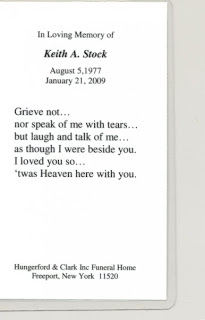
Funeral Card Friday - Keith Stock


So this isn't an ancestor of mine, but because of the date and the timing of Funeral Card Friday, I thought it would be an appropriate memorial to highlight my cousin, Keith, who died two years ago today. It was very sudden and was while he was on his honeymoon, which made it just all the more awful, and it's still difficult to think about today, so I try to instead think about the fun we had as kids, and how we had started reconnecting as adults shortly before he died, and just how much fun we had at his wedding days before he died. We should be sad because we miss the people we love, but we should be happy about the time we got to spend with them.

Which leads me into this - we spend so much time finding and getting to know our family from generations past, relatives long gone, ancestors we'll never meet, and that's fantastic. That is a wonderful thing. But let's not spend so much time with family who are dead that we miss the moments we have with our family who are living.

Hope y'all have a great weekend!

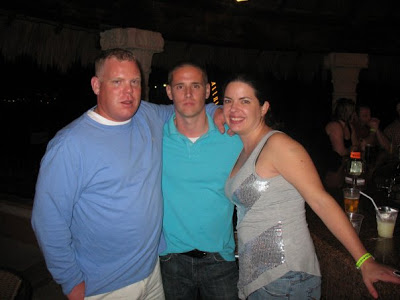
Keith, my brother, and me in Mexico for Keith's wedding, 17 January 2009.

Matrilineal Monday - Musings on matrilineal genealogy

I like this category very much, I have to say. I think I'll enjoy posting on this in the future. But for today, I just wanted to comment on matrilineal genealogy, which traces the female branches of a tree.

When I first started becoming seriously interested in genealogy, I had huge sheets (you had to roll them out on the floor, they were so big) of paper tracing (rather inaccurately, too, it turns out) the Raynor family tree, which is my mother's line. As I've noted before, that tree was pretty extensive before I'd even started, researched and recorded by people years before I was even born. I would sit there for hours reading all the names and recording them into my own book. I was fascinated by it. And saddened by it.

I wasn't on it.

My mother was. But as with every other female on that tree, the Raynor line stopped with her. Now, I get that, especially when trees were recorded on paper, which does not have the infinite space that the Internet does, you have to make choices about who to continue to follow. And I get that for Raynor genealogy, for example, it can be easier to just follow anyone who keeps the Raynor name. But just because I'm a Gorry doesn't make me any less a Raynor than my Raynor cousins, the children of my mother's brothers. We're all half Raynor. We're all branches of that same tree.

At the same time, because it was a Raynor family tree, there was no history on the women who married into it. So I had no information on my great-great grandmother Annie Poole's forebears or origins. I saw Seamans and Halls and all sorts of other female lines on this tree that I knew nothing about.

So, according to these genealogists, if I married into a tree, it was my husband who would be traced. And as a female on my father's tree, my children would not be included.

So needless to say, as a female genealogist, I've been very interested in matrilineal genealogy from the very beginning.

Unfortunately, because we live in a society where women take their husband's names, the women on our trees often get lost, and consequently, so do their families. We can choose to trace the male line as far back as we can go, and that is fine - doing more than that can be time-consuming and can lead to many brick walls - but genealogy is never a straight line. It's not called a "family tree" for nothing. I may have the name Gorry but I am the product of Raynors and Bergs and Stutzmanns and Caseys and a thousand other families, too. And when I marry and have children, I don't want that to be lost - I want them to know and appreciate all the lines they come from, both male and female.

And as a quick note, even though I am at work today, I wish everyone a happy Martin Luther King Jr. Day - hope we all take a minute today to think about his message and vision and everything he stood for!