
...to remember all the souls who were lost nine years ago today and their loved ones who were left behind and must somehow go on. Every family tree has someone who was lost too suddenly, too violently, and/or too soon, and every family tree has someone who lived through a significant event or time in history, and we honor them by never forgetting, just as all the victims of 9/11, living and dead, are honored by our remembrance of them and the remembrance of them by future generations...
Raynor family reunion: your living relatives are important, too
I mean, duh - the fact that your living relatives are just as important as your dead ones should go without saying, but I know from personal experience, sometimes I spend so much time looking up those who have gone before me that I sometimes forget about the ones who are here with me, not only as a valuable source of family stories and information, but as people, as friends, and as family. And I'm not just talking about the cousins and aunts and uncles, but the second cousins and so-and-so number cousins removed so-and-so many times. These are the people you are connected to now. These are the people your grandchildren will be looking up someday.
On July 31, my mom's side of the family, the Raynors, had a family reunion at my aunt's house. Almost 50 descendants of my great grandparents, Monroe Raynor and Amelia Berg Raynor, showed up to this thing - my mother's cousins, my cousins, my second cousins, and now the next generation of Raynor-Bergs, as my second cousins get married and have kids. None of my great-grandparents seven children are still alive, but my 95-year-old grandmother, Mary Cronin Raynor, was also there, so we had four generations under one roof. It was pretty amazing. Many of these relatives I knew from other family reunions - many of those many, though, I hadn't seen in close to 15 years. Others I knew of from my genealogy research but had never met. Some I knew nothing of. But you could see some similarities in some of the cousins, like the gigantically tall gene my cousin Cliff and second cousin David share, or how so many of my mom's female cousins look like each other, or like my grandfather's sisters.
And of course, the topic of genealogy was part of the day. My aunt ordered copies of the family tree compilation put together by the Freeport village historian in the 1970s, enough so everyone could bring a copy home with them. Everyone brought photos of their families and I brought some of the family genealogy I had worked on. Old photos of my grandfather's generation and his parents generation were brought out and we marveled at how easy it was to pick out my grandfather in one, even though he was only 10, and how one of Amelia Berg's brothers looked exactly like my mom's brother Cliff, and how much they both look like Teddy Roosevelt. And in that same photo, we made up stories about Amelia's brother Royal Howard, who stood out as looking handsome, suave, debonair, and by far the best-dressed of the bunch. And at the end of the day, we did what all families should do, especially those who are so genealogically-inclined, we took a family portrait on the front lawn, a souvenir of a fun family get together and another record of our family for future generations to use in their own research.
On July 31, my mom's side of the family, the Raynors, had a family reunion at my aunt's house. Almost 50 descendants of my great grandparents, Monroe Raynor and Amelia Berg Raynor, showed up to this thing - my mother's cousins, my cousins, my second cousins, and now the next generation of Raynor-Bergs, as my second cousins get married and have kids. None of my great-grandparents seven children are still alive, but my 95-year-old grandmother, Mary Cronin Raynor, was also there, so we had four generations under one roof. It was pretty amazing. Many of these relatives I knew from other family reunions - many of those many, though, I hadn't seen in close to 15 years. Others I knew of from my genealogy research but had never met. Some I knew nothing of. But you could see some similarities in some of the cousins, like the gigantically tall gene my cousin Cliff and second cousin David share, or how so many of my mom's female cousins look like each other, or like my grandfather's sisters.
And of course, the topic of genealogy was part of the day. My aunt ordered copies of the family tree compilation put together by the Freeport village historian in the 1970s, enough so everyone could bring a copy home with them. Everyone brought photos of their families and I brought some of the family genealogy I had worked on. Old photos of my grandfather's generation and his parents generation were brought out and we marveled at how easy it was to pick out my grandfather in one, even though he was only 10, and how one of Amelia Berg's brothers looked exactly like my mom's brother Cliff, and how much they both look like Teddy Roosevelt. And in that same photo, we made up stories about Amelia's brother Royal Howard, who stood out as looking handsome, suave, debonair, and by far the best-dressed of the bunch. And at the end of the day, we did what all families should do, especially those who are so genealogically-inclined, we took a family portrait on the front lawn, a souvenir of a fun family get together and another record of our family for future generations to use in their own research.
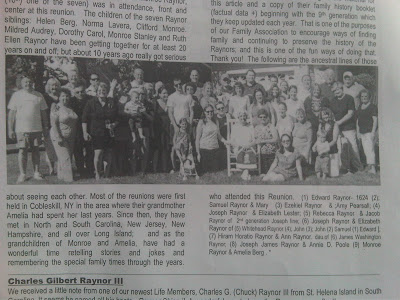 |
| July 31 Raynor reunion family photo as printed in the Raynor Family Association's August 2010 bulletin. |
Taking a stroll through history: my grandmother's high school yearbook
I think that, often, when we're doing genealogy, we get up in the formality of it all - finding records, verifying records, recording all our information as accurately as possible. It's thorough, and it's good, but it's kind of cold and impersonal. It takes the human face off of genealogy - this is family, after all. It's okay to not treat them completely like strangers.
I talked about it a little when I talked about the importance of recording nicknames as well as full names, about recording the names their family and friends knew them by, but I think it's also why photos and letters and personal effects are important, too. These things remind you that this person isn't just a name and a date, that he or she was real - they had friends and hobbies and sometimes they took goofy photos instead of the formal portraits you usually see. They made mistakes and had flaws - they fell in love and they had bad hair days.
Anyway, I have all four of my grandmother, Mary Cronin Raynor's, high school yearbooks. She graduated from Freeport High School in Freeport, Long Island, New York, in 1933. This is the inside cover of the yearbook from the year she graduated:

You know, like I think sometimes we have these pictures and focus on these pictures and put the emphasis on these pictures of our ancestors when they were old. Sometimes we see them as babies. Or when they get married. But they were teenagers, too. Some of them even went to high school like we did.

That's my grandmother in the upper right hand corner. To be honest, she looks a lot older and mature than the 18-year-olds I went to high school with. A lot of the kids in her yearbook do, I think. But some of the girls look young, with their smiling. As do the boys, with their goofy hairdos. My grandmother's caption reads, "Plain without pomp, rich without show," which I think describes her perfectly, and her activities include hockey, basketball, glee club, the Masque and Wig club, Spanish club, and science club. Which are all things I never would have pictured her doing, so that's kind of cool.

That's my grandfather, Clifford Raynor, who was Mary Cronin's husband, in the top left corner. He was a year older but graduated the same year as her. Not surprisingly, he was not involved in any school activities, and his caption, "Be silent, and safe; silence never betrays you," feels right when I remember the way he was.
I talked about it a little when I talked about the importance of recording nicknames as well as full names, about recording the names their family and friends knew them by, but I think it's also why photos and letters and personal effects are important, too. These things remind you that this person isn't just a name and a date, that he or she was real - they had friends and hobbies and sometimes they took goofy photos instead of the formal portraits you usually see. They made mistakes and had flaws - they fell in love and they had bad hair days.
Anyway, I have all four of my grandmother, Mary Cronin Raynor's, high school yearbooks. She graduated from Freeport High School in Freeport, Long Island, New York, in 1933. This is the inside cover of the yearbook from the year she graduated:
You know, like I think sometimes we have these pictures and focus on these pictures and put the emphasis on these pictures of our ancestors when they were old. Sometimes we see them as babies. Or when they get married. But they were teenagers, too. Some of them even went to high school like we did.
That's my grandmother in the upper right hand corner. To be honest, she looks a lot older and mature than the 18-year-olds I went to high school with. A lot of the kids in her yearbook do, I think. But some of the girls look young, with their smiling. As do the boys, with their goofy hairdos. My grandmother's caption reads, "Plain without pomp, rich without show," which I think describes her perfectly, and her activities include hockey, basketball, glee club, the Masque and Wig club, Spanish club, and science club. Which are all things I never would have pictured her doing, so that's kind of cool.
That's my grandfather, Clifford Raynor, who was Mary Cronin's husband, in the top left corner. He was a year older but graduated the same year as her. Not surprisingly, he was not involved in any school activities, and his caption, "Be silent, and safe; silence never betrays you," feels right when I remember the way he was.
And the universe chimes into the genealogical conversation...
You know how I was just talking about the importance of sharing genealogical information? It's like the universe heard and was pleased...
I received an e-mail this afternoon from one of the cousins I correspond with regarding our shared family trees re: my third great grandfather on my dad's side, John Ricklefs. You may recall that, judging from not one but both his sons doing not one but multiple stints in prison for multiple bank robberies, John Ricklefs probably never won any Father of the Year awards for his parenting skills, or lack thereof.
I knew where he was from, when he was born, when and where he was married, and that he and his wife, Meta Tiedemann, moved all the way out to the boondocks of Suffolk County by 1930, living on a farm in Patchogue. But the trail went cold after the 1930 census. I attempted to obtain a death record from the Patchogue village clerk but without any way to narrow down what year he might have died, outside of telling her "somewhere between 1930 and this morning," or going out to Patchogue myself to see if they would let me look through the files (and while Patchogue is close, it is not close by foot, which is how I currently travel), I had hit yet another deadend. It was not a typical deadend, though. A death after 1930 is a fairly recent death, which meant not only was it very likely there was a record, but that somewhat still alive might actually remember him. So I had a feeling it was a temporary dead end, but I didn't know how long I would have to wait.
I guess that answer would be, until today. So, this is the message my cousin sent:
Mary, it's been a while, I kept looking for information on John & Meta Ricklefs. I found a death listing for John Ricklefs, in the 10 March 1937 issue of the Mis Island Mail. It was a local newspaper. John Ricklefs died 23 Feb 1937, at the Patchogue Community Hospital. The address was 311 Bay Ave., Patchogue.
I mean, how cool is that? One short e-mail and a ton of brand new information. So, I guess my next step will be to either go to a library that has the Mid Island Mail on microfilm and look for the obit, and/or contact this village clerk in Patchogue again and see if an exact date will get me the record I'm looking for. I already know his parents names, so I'm not looking for that, but anytime you can find more than one record verifying the information you have, it's helpful and further proof. And actually, on John's marriage certificate, I'm not entirely certain of his mother's maiden name. So that would be helpful if her name is on it. Also, the death record might say if his wife Meta was still alive or not, when his birthday is, what his occupation was, etc. etc. I'm very excited, and oh so grateful that I have family I can turn to when I need help finding something out, and not only do they help me when I ask, but they keep it in the back of their heads and continue the search for me. Well, not for me. For us.
I received an e-mail this afternoon from one of the cousins I correspond with regarding our shared family trees re: my third great grandfather on my dad's side, John Ricklefs. You may recall that, judging from not one but both his sons doing not one but multiple stints in prison for multiple bank robberies, John Ricklefs probably never won any Father of the Year awards for his parenting skills, or lack thereof.
I knew where he was from, when he was born, when and where he was married, and that he and his wife, Meta Tiedemann, moved all the way out to the boondocks of Suffolk County by 1930, living on a farm in Patchogue. But the trail went cold after the 1930 census. I attempted to obtain a death record from the Patchogue village clerk but without any way to narrow down what year he might have died, outside of telling her "somewhere between 1930 and this morning," or going out to Patchogue myself to see if they would let me look through the files (and while Patchogue is close, it is not close by foot, which is how I currently travel), I had hit yet another deadend. It was not a typical deadend, though. A death after 1930 is a fairly recent death, which meant not only was it very likely there was a record, but that somewhat still alive might actually remember him. So I had a feeling it was a temporary dead end, but I didn't know how long I would have to wait.
I guess that answer would be, until today. So, this is the message my cousin sent:
Mary, it's been a while, I kept looking for information on John & Meta Ricklefs. I found a death listing for John Ricklefs, in the 10 March 1937 issue of the Mis Island Mail. It was a local newspaper. John Ricklefs died 23 Feb 1937, at the Patchogue Community Hospital. The address was 311 Bay Ave., Patchogue.
I mean, how cool is that? One short e-mail and a ton of brand new information. So, I guess my next step will be to either go to a library that has the Mid Island Mail on microfilm and look for the obit, and/or contact this village clerk in Patchogue again and see if an exact date will get me the record I'm looking for. I already know his parents names, so I'm not looking for that, but anytime you can find more than one record verifying the information you have, it's helpful and further proof. And actually, on John's marriage certificate, I'm not entirely certain of his mother's maiden name. So that would be helpful if her name is on it. Also, the death record might say if his wife Meta was still alive or not, when his birthday is, what his occupation was, etc. etc. I'm very excited, and oh so grateful that I have family I can turn to when I need help finding something out, and not only do they help me when I ask, but they keep it in the back of their heads and continue the search for me. Well, not for me. For us.
Nancy Drew and the Case of the Martin Nehr Comment
So as I mentioned in my previous post, a Horst5457 posted a comment on August 3 on my 5th great grandfather Martin Nehr's profile on my Ancestry.com family tree. This is what he (or she, I suppose) wrote:
Sippenbuch Heppenheim 3 Nr.7171 Kind Nr.5 Martin Neher *29.05.1806 Hambach ,+USA OO am 25.11.1834 Heppenheim mit Anna Maria Mitsch *18.11.1803Heppenheim,+19.02.1854 Hambach er flüchtet 1847 nach Amerika bei Zurücklassung von Frau und Kindern. Eltern von Martin Neher Johann Neher *12.02.1776 Hambach,+28.12.1823 Hambach Nr.7171 oo am 18.02.1800 Heppenheim mit Anna Maria Petermann *28.07.1776 hambach,+01.04.1849 Hambach als Witwe
When you plug that into Babelfish, this is how it gets translated:
Kinship book Heppenheim 3 Nr.7171 child Nr.5 Martin Neher *29.05.1806 Hambach, +USA OO to 25.11.1834 Heppenheim with Anna Maria Mitsch *18.11.1803Heppenheim, +19.02.1854 Hambach it flees 1847 to America in leaving of woman and children. Parents of Martin Neher Johann Neher *12.02.1776 Hambach, +28.12.1823 Hambach Nr.7171 oo to 18.02.1800 Heppenheim with Anna Maria Petermann *28.07.1776 hambach, +01.04.1849 Hambach as a widow
I'm pretty sure that's not entirely accurate...
My first thought, of course, is a pat on the back to myself at the guess I took that the "Anna Maria Mitch" listed on her daughter Catherine's death certificate probably should've been spelled the more German "Mitsch" seems to have some confirmation. It also seems possible that Martin and Anna Maria came to America - so that gives me some American records to look at, possibly. And it gives me towns in Germany to look at.
Of course, I don't know how reliable this information is, if at all, but it gives me some place to start looking, where before I had no place to start looking. And where I have some place to start, I have some place to go. I'm hopeful, as I usually am when I get new leads, at figuring this comment out - Nancy Drew ain't got nothing on me! :)
Sippenbuch Heppenheim 3 Nr.7171 Kind Nr.5 Martin Neher *29.05.1806 Hambach ,+USA OO am 25.11.1834 Heppenheim mit Anna Maria Mitsch *18.11.1803Heppenheim,+19.02.1854 Hambach er flüchtet 1847 nach Amerika bei Zurücklassung von Frau und Kindern. Eltern von Martin Neher Johann Neher *12.02.1776 Hambach,+28.12.1823 Hambach Nr.7171 oo am 18.02.1800 Heppenheim mit Anna Maria Petermann *28.07.1776 hambach,+01.04.1849 Hambach als Witwe
When you plug that into Babelfish, this is how it gets translated:
Kinship book Heppenheim 3 Nr.7171 child Nr.5 Martin Neher *29.05.1806 Hambach, +USA OO to 25.11.1834 Heppenheim with Anna Maria Mitsch *18.11.1803Heppenheim, +19.02.1854 Hambach it flees 1847 to America in leaving of woman and children. Parents of Martin Neher Johann Neher *12.02.1776 Hambach, +28.12.1823 Hambach Nr.7171 oo to 18.02.1800 Heppenheim with Anna Maria Petermann *28.07.1776 hambach, +01.04.1849 Hambach as a widow
I'm pretty sure that's not entirely accurate...
My first thought, of course, is a pat on the back to myself at the guess I took that the "Anna Maria Mitch" listed on her daughter Catherine's death certificate probably should've been spelled the more German "Mitsch" seems to have some confirmation. It also seems possible that Martin and Anna Maria came to America - so that gives me some American records to look at, possibly. And it gives me towns in Germany to look at.
Of course, I don't know how reliable this information is, if at all, but it gives me some place to start looking, where before I had no place to start looking. And where I have some place to start, I have some place to go. I'm hopeful, as I usually am when I get new leads, at figuring this comment out - Nancy Drew ain't got nothing on me! :)
It's all about sharing...
Genealogy, in my opinion, is all about sharing. It's about sharing tips. It's about sharing information. You probably do it not just for yourself but to keep the family tree going to share with future generations of your family. Most of my information I've gotten through my own legwork and from vital records and other documents and photos, but many times, I've been able to find that information or a missing link on a particular branch because someone shared that information with me and helped me. I will never understand these people who have private family trees on Ancestry.com. I get that you are the person who put in the hard work and the long hours to put that tree together and you may resent some stranger you don't know (who is probably actually a distant relative, if they're looking at your tree) coming in and taking that information, all la di da, but I honestly believe we can't do this if we don't help each other. Plus, you're going to pass that tree down to your children, right? They're going to have that information without doing all the hard work and putting in the long hours - you're not going to make them start from scratch when you already have the information they'll need.
Anyway, was just thinking about this because of an interesting comment I got on my Ancestry.com family tree (it's called the Gorry-Raynor family tree). Two of my recently discovered ancestors are my 5th great-grandparents on my dad's side, Martin Nehr and Anna Maria Mitsch. Though I was ecstatic to have found out that new information, it had, again, left me at a dead end, just a generation further back. So, on Aug. 3, someone left a comment on Martin Nehr's profile on my tree. I'd never gotten a comment before, so that was kind of exciting. Of course, the comment is also in German, but I'm not sure genealogy would be half as fun if it wasn't so much of a challenge so much of the time. But basically it looks to have birth and death dates and places for Martin and Anna Maria, as well as the parents of Martin, which would take me back yet another generation. But I wonder - who is the guy who posted the info? His profile is extremely uninformative. Where is his information from? How reliable is it? Is he an as yet undiscovered cousin of sorts who also has Martin and Anna Maria on his family tree? So this is the current genealogical mystery I am attempting to solve...
Anyway, was just thinking about this because of an interesting comment I got on my Ancestry.com family tree (it's called the Gorry-Raynor family tree). Two of my recently discovered ancestors are my 5th great-grandparents on my dad's side, Martin Nehr and Anna Maria Mitsch. Though I was ecstatic to have found out that new information, it had, again, left me at a dead end, just a generation further back. So, on Aug. 3, someone left a comment on Martin Nehr's profile on my tree. I'd never gotten a comment before, so that was kind of exciting. Of course, the comment is also in German, but I'm not sure genealogy would be half as fun if it wasn't so much of a challenge so much of the time. But basically it looks to have birth and death dates and places for Martin and Anna Maria, as well as the parents of Martin, which would take me back yet another generation. But I wonder - who is the guy who posted the info? His profile is extremely uninformative. Where is his information from? How reliable is it? Is he an as yet undiscovered cousin of sorts who also has Martin and Anna Maria on his family tree? So this is the current genealogical mystery I am attempting to solve...
I hail from a tiny town in Bavaria...
I guess I've always been aware of this but it's striking me now, in particular, as I'm looking into the Stutzmann branch of my tree, that while my background is diverse and taken as a whole, I come from all over, from general areas like "Germany" or "Western Europe," that each of my individual branches come from specific localities and in many cases, from a single town, for many generations back.
I guess it's like over here, on Long Island, I'm not just from New York or Long Island, I'm from Freeport. My family is from Freeport. For generations back, my family is from Freeport and if you go far enough back, I can claim the whole village as relations.
So, I'm looking at the Stutzmanns, my father's mother's family, who I've always known are from a tiny town in Bavaria called Grossbockenheim. Grossbockenheim doesn't exist anymore, having merged with nearby neighbor "Little Bockenheim" to form just the regular town of Bockenheim, but looking at this particular branch, it's striking me that the Stutzmanns are really from there. Their fathers and mothers, their grandparents, their cousins, their great-grandparents. Each of my ancestors married someone else from the town, as their parents did before and their children would do after. Everyone was married in the same church and the cemeteries there are probably filled with my relatives, both near and distant. Grossbockenheim is full of Stutzmann history, and the Stutzmanns are intregal to Grossbockenheim history. Ah, the intertwining of genealogy and history yet again. It's just so exciting. And finding all of this out really makes me want to go there and see where the Stutzmanns hail from, to walk where they walked, to breathe the air they breathed. And then repeat with all the other branches of my tree :)
Just as an added note, I have always felt that, Raynor American-English colonial research aside, that I would have the most genealogical success with my German roots, and it appears, at least from the FamilySearch website, that they did in fact keep meticulous, detailed, and organized records. So it seems that while I very much identify with my Irish roots, that I may in fact be much more German in personality than I originally thought...
I guess it's like over here, on Long Island, I'm not just from New York or Long Island, I'm from Freeport. My family is from Freeport. For generations back, my family is from Freeport and if you go far enough back, I can claim the whole village as relations.
So, I'm looking at the Stutzmanns, my father's mother's family, who I've always known are from a tiny town in Bavaria called Grossbockenheim. Grossbockenheim doesn't exist anymore, having merged with nearby neighbor "Little Bockenheim" to form just the regular town of Bockenheim, but looking at this particular branch, it's striking me that the Stutzmanns are really from there. Their fathers and mothers, their grandparents, their cousins, their great-grandparents. Each of my ancestors married someone else from the town, as their parents did before and their children would do after. Everyone was married in the same church and the cemeteries there are probably filled with my relatives, both near and distant. Grossbockenheim is full of Stutzmann history, and the Stutzmanns are intregal to Grossbockenheim history. Ah, the intertwining of genealogy and history yet again. It's just so exciting. And finding all of this out really makes me want to go there and see where the Stutzmanns hail from, to walk where they walked, to breathe the air they breathed. And then repeat with all the other branches of my tree :)
Just as an added note, I have always felt that, Raynor American-English colonial research aside, that I would have the most genealogical success with my German roots, and it appears, at least from the FamilySearch website, that they did in fact keep meticulous, detailed, and organized records. So it seems that while I very much identify with my Irish roots, that I may in fact be much more German in personality than I originally thought...
FamilySearch: Following the Stutzmann-Schlick line...
Last entry I talked about this project I had just found out about on the FamilySearch website and how excited I was about it. Well, the excitement continues. The problem with the normal FamilySearch website is that while a lot of their information comes from actual vital records and is therefore accurate, a lot of it comes from user input, and is therefore in many cases very inaccurate, and you have to figure out which of the entries to trust and which to discard. But this new project seems to be based solely on input from vital records, and even though many of them do not have an original image indexed, there are many that include a transcription of said vital record.
So in that vein, let's talk about the Stutzmanns. As any of you have read this blog know, the Stutzmanns (my paternal grandmother's family) had been a fairly prominent family in the Ridgewood area of Queens and Brooklyn and within that local German community, so some work had already been done on their family tree (some of it not at all right, but for the most part fairly accurate) before I even entered the genealogy game. So, thanks to the work of others, I could go back 8 generations to the late 1700s in a town called Grossbockenheim in Germany to the parents of Peter Stutzmann, who with his wife Charlotte Schlick had a bunch of kids whose lines have all been pretty well traced down to now.
Through my own research I had discovered that Charlotte's real first name was probably Louise, since in Germany apparently every kid gets the Christian name and then the middle name, and no one goes by their Christian name and everyone goes by their middle name, so you end up with a bunch of sons named Johann and a bunch of daughters named Maria. Anyway, today I decided to focus my search on this line, since in all my own research, I've never been able to get past Peter's parents, who I knew to be Christoph Stutzmann and Jacobine Last Name Unknown, or Charlotte. Today I found a transcription for a marriage certificate for one J. Peter Stutzmann and one Charlotte Schlick. A birth certificate transcription for one of their kids showed that Peter's real first name was Johann, which to be fair, I should've guessed anyway. So, this marriage transcription - the ages for both Peter and Charlotte are right, the year, 1841, jibes with when they started having kids, the town is right, and lo and behold, we have parents' names for both of them. Score!
So, according to the transcription, Peter's parents are Michael Stutzmann and Jacobina Blasius. Though the father's name doesn't match, wacky German naming traditions means it's possible that both Michael and Christoph are the right name for Peter's dad. Or, with the spotty accuracy of the original info I built my research on for this branch, it's possible Christoph is completely wrong. But Jacobine and Jacobina jibe, so that's another point in this transcription's favor. And we also have names for Charlotte's parents - Rudolph Schlick (which seems right seeing as how many Rudolph's, including Charlotte's son, as well as my great great grandfather, ended up on this Stutzmann branch) and Ottile Elisabetha Dhuy (which, it seems her last name should probably be D'Huy, which seems to be a Belgian name).
You always have to take new information with a grain of salt, but you have to start someplace, and these new leads give me a place to start to build my own foundation for this information as I go about trying to verify or disprove. The point is...the Case of the Stutzmann Tree continues!
So in that vein, let's talk about the Stutzmanns. As any of you have read this blog know, the Stutzmanns (my paternal grandmother's family) had been a fairly prominent family in the Ridgewood area of Queens and Brooklyn and within that local German community, so some work had already been done on their family tree (some of it not at all right, but for the most part fairly accurate) before I even entered the genealogy game. So, thanks to the work of others, I could go back 8 generations to the late 1700s in a town called Grossbockenheim in Germany to the parents of Peter Stutzmann, who with his wife Charlotte Schlick had a bunch of kids whose lines have all been pretty well traced down to now.
Through my own research I had discovered that Charlotte's real first name was probably Louise, since in Germany apparently every kid gets the Christian name and then the middle name, and no one goes by their Christian name and everyone goes by their middle name, so you end up with a bunch of sons named Johann and a bunch of daughters named Maria. Anyway, today I decided to focus my search on this line, since in all my own research, I've never been able to get past Peter's parents, who I knew to be Christoph Stutzmann and Jacobine Last Name Unknown, or Charlotte. Today I found a transcription for a marriage certificate for one J. Peter Stutzmann and one Charlotte Schlick. A birth certificate transcription for one of their kids showed that Peter's real first name was Johann, which to be fair, I should've guessed anyway. So, this marriage transcription - the ages for both Peter and Charlotte are right, the year, 1841, jibes with when they started having kids, the town is right, and lo and behold, we have parents' names for both of them. Score!
So, according to the transcription, Peter's parents are Michael Stutzmann and Jacobina Blasius. Though the father's name doesn't match, wacky German naming traditions means it's possible that both Michael and Christoph are the right name for Peter's dad. Or, with the spotty accuracy of the original info I built my research on for this branch, it's possible Christoph is completely wrong. But Jacobine and Jacobina jibe, so that's another point in this transcription's favor. And we also have names for Charlotte's parents - Rudolph Schlick (which seems right seeing as how many Rudolph's, including Charlotte's son, as well as my great great grandfather, ended up on this Stutzmann branch) and Ottile Elisabetha Dhuy (which, it seems her last name should probably be D'Huy, which seems to be a Belgian name).
You always have to take new information with a grain of salt, but you have to start someplace, and these new leads give me a place to start to build my own foundation for this information as I go about trying to verify or disprove. The point is...the Case of the Stutzmann Tree continues!
There you are, Sophia Ricklefs! That rumbling sound you hear is another brick wall being knocked down with a giant sledgehammer
So I've been telling my friend Sam lately about my interest in genealogy - gushing more like it. I blame him, because unlike my other friends who just tune me out, he actually pretends to be interested. And not only does he pretend to be interested but seeing how passionate I am about it, he's been pushing me to pursue a career as a professional genealogist. So today he sent me several links about websites and Youtube channels and New York metro genealogy associations and whatnot. The Youtube channel he sent me was the Genealogy Guy. I clicked on a video at random. Well, I'm guessing not at random - I'm pretty sure the universe, or maybe someone in my family, was guiding me. The video was about a project being conducted by our good friends the Mormons to make original copies of all sorts of genealogical records available online, and so far, for free. God bless those Mormons - if they didn't have to keep all their family lines straight, we might still be in the genealogy stone age. The best part about this is it's on their website, www.familysearch.org. I am on that site all the time, all the fricking time, and I never knew this project existed. From the home page, you go to the section "What's New" and click on the link "see prototype for searching millions of records." I haven't explored it thoroughly yet. I only just discovered it about 10 minutes ago but the results were already so exciting that I had to post and share about it.
I typed in "Meta Ricklefs," just because she was the first name to come to my head. The typical, Ancestry.com fare came up - 1900 census, 1920 census. But then I saw 1905 New York Census...1892 New York census...both with original images available. I had never seen those censuses before. 1905 didn't tell me anything I didn't already know, though the fact that it's there is amazing. 1892 was a whole other ballgame.
The 1890 U.S. census, as we all know, was mostly destroyed in a fire. For those of us living today, 1880-1920 is an important period for us...that's when many of our families came over. That's when many of our grandparents and great grandparents and even great great grandparents, for whom we have later census records or military records or whatnot, were born. So the loss of the 1890 census is a huge loss in genealogy research. Well, the 1892 New York census was taken only 2 years later. (Duh). It doesn't have much information beyond name, age, and place of birth. What it does have, in regards to my research, is a person I've only seen in other people's records and who I had no idea had even come over to America - Sophia Ricklefs.
Now, I had looked up Meta (Tiedemann) Ricklefs, who was living with her husband, John, and their kids John, Meta (my great great grandmother), and Olga. And right below 4 month old Olga is listed Sophia Ricklefs, 57, born in Germany. Now, no family relations are given, but I know from John and Meta's marriage record that John's mother's name is Sophie or Sophia. The age puts her at the right age to be his mom. If she was living here, that means she might have died here, and there could be a death record for her. There could be a passenger manifest record of her. I mean, I can't wait to go and check. 10 minutes and I've already opened new research avenues. It's amazing, how you can be standing still, banging your head against a wall over and over and just when you're about to give up, you bang one more time, and that's what knocks a hole in it.
So, new Ricklefs avenues to pursue, and I haven't even looked up anybody else in my tree yet. I can't wait to see what I discover...so thank you, Sam, for being such an annoying, pushy bastard :)
I typed in "Meta Ricklefs," just because she was the first name to come to my head. The typical, Ancestry.com fare came up - 1900 census, 1920 census. But then I saw 1905 New York Census...1892 New York census...both with original images available. I had never seen those censuses before. 1905 didn't tell me anything I didn't already know, though the fact that it's there is amazing. 1892 was a whole other ballgame.
The 1890 U.S. census, as we all know, was mostly destroyed in a fire. For those of us living today, 1880-1920 is an important period for us...that's when many of our families came over. That's when many of our grandparents and great grandparents and even great great grandparents, for whom we have later census records or military records or whatnot, were born. So the loss of the 1890 census is a huge loss in genealogy research. Well, the 1892 New York census was taken only 2 years later. (Duh). It doesn't have much information beyond name, age, and place of birth. What it does have, in regards to my research, is a person I've only seen in other people's records and who I had no idea had even come over to America - Sophia Ricklefs.
Now, I had looked up Meta (Tiedemann) Ricklefs, who was living with her husband, John, and their kids John, Meta (my great great grandmother), and Olga. And right below 4 month old Olga is listed Sophia Ricklefs, 57, born in Germany. Now, no family relations are given, but I know from John and Meta's marriage record that John's mother's name is Sophie or Sophia. The age puts her at the right age to be his mom. If she was living here, that means she might have died here, and there could be a death record for her. There could be a passenger manifest record of her. I mean, I can't wait to go and check. 10 minutes and I've already opened new research avenues. It's amazing, how you can be standing still, banging your head against a wall over and over and just when you're about to give up, you bang one more time, and that's what knocks a hole in it.
So, new Ricklefs avenues to pursue, and I haven't even looked up anybody else in my tree yet. I can't wait to see what I discover...so thank you, Sam, for being such an annoying, pushy bastard :)
Raynors, Raynors, everywhere...
You can't get away from those Raynors or any of those pesky Hempstead founding families anywhere on Long Island, it seems. Last Friday I had to go to Riverhead for work. Riverhead is a good 60 miles east of the Hempstead Plains, where the families originally settled, and even a good almost 20 miles west of Southampton, where many of those founding families ended up. Yet, I was walking around town following my assignment and suddenly found myself on Ackerley Street. Followed by a Hallett Street. And a Duryea Street. The same good old names you find over and over again here. I guess I shouldn't have been surprised, but I was. Anyway, there was also, of course, a Raynor Street. I tried to find it but my GPS wasn't working and it was too hot to go wandering around for long looking for it. I was disappointed, since I wanted to take a picture that I could post in this blog, but the fact remains, on Long Island, you can find Raynors or evidence of Raynors just about everywhere.
A wealth of resources, the luck of the draw
We have pretty good genealogical records here in America. We have church archives, local government archives, federal government archives, military records, passenger manifests, census records, and all preserved pretty well and made reasonably available to the public, both key to successful genealogical research.
Europe seems to have pretty good records as well - of course, no government is perfect. Ireland, for some reason, destroyed all of its census information after it had been collected. I still wish at certain moments that I could go back in time and keep the 1890 U.S. census from being almost completely destroyed in a fire. For almost everyone living in 2010, that was an important piece of somewhat recent research that's just gone forever.
But lately I've been thinking about how lucky we are here by all the resources that are available to us - I know it's something I tend to take for granted, and in fact so much information is so readily available that I can get kind of impatient (what, me, get impatient?) when I have to actually look hard and dig deep for a piece of the puzzle. But I guess governments are kind of like people, with different personalities. Some of them, like me, like to make and keep lists. Others couldn't care less about that kind of thing. Some countries don't have a high enough literacy rate to make keeping records feasible. Some countries that are too poor have more important things to worry about like feeding people. Others have volatile tempers and are too busy with civil wars and internal fighting and the records get lost, usually for good. But I think of some of my good friends, most of whom come from Latin American countries, and their parents never had birth certificates. And their town churches back home, along with all their records, have burned down. No census was ever taken, and their grandparents or great-grandparents died too young to ask them about passing on an oral history.
But in those cases, especially, is when oral histories become important, because that's all you have. And while it's not hard evidence as far as genealogical research goes, it's good evidence - your grandmother might not be able to tell you about her grandparents, but she can tell you about her parents and her siblings and what it was like growing up, and depending on who you talk to, other people will remember other things and other people. And if you write that down, straight from the horses mouth so to speak, or record them recounting their own stories, then 100 years from now, that's pretty much primary source information, and it helps to start your family story, at the very least, for future generations.
But I think of my friends a lot when I do this research and when I'm getting really frustrated and they're laughing at me because I'm always looking to be able to go further back, and there's no way they'll ever be able to go further back, and it makes me realize how lucky I am and how important keeping these records for future generations is.
Europe seems to have pretty good records as well - of course, no government is perfect. Ireland, for some reason, destroyed all of its census information after it had been collected. I still wish at certain moments that I could go back in time and keep the 1890 U.S. census from being almost completely destroyed in a fire. For almost everyone living in 2010, that was an important piece of somewhat recent research that's just gone forever.
But lately I've been thinking about how lucky we are here by all the resources that are available to us - I know it's something I tend to take for granted, and in fact so much information is so readily available that I can get kind of impatient (what, me, get impatient?) when I have to actually look hard and dig deep for a piece of the puzzle. But I guess governments are kind of like people, with different personalities. Some of them, like me, like to make and keep lists. Others couldn't care less about that kind of thing. Some countries don't have a high enough literacy rate to make keeping records feasible. Some countries that are too poor have more important things to worry about like feeding people. Others have volatile tempers and are too busy with civil wars and internal fighting and the records get lost, usually for good. But I think of some of my good friends, most of whom come from Latin American countries, and their parents never had birth certificates. And their town churches back home, along with all their records, have burned down. No census was ever taken, and their grandparents or great-grandparents died too young to ask them about passing on an oral history.
But in those cases, especially, is when oral histories become important, because that's all you have. And while it's not hard evidence as far as genealogical research goes, it's good evidence - your grandmother might not be able to tell you about her grandparents, but she can tell you about her parents and her siblings and what it was like growing up, and depending on who you talk to, other people will remember other things and other people. And if you write that down, straight from the horses mouth so to speak, or record them recounting their own stories, then 100 years from now, that's pretty much primary source information, and it helps to start your family story, at the very least, for future generations.
But I think of my friends a lot when I do this research and when I'm getting really frustrated and they're laughing at me because I'm always looking to be able to go further back, and there's no way they'll ever be able to go further back, and it makes me realize how lucky I am and how important keeping these records for future generations is.
A slow summer...and a trip to Oyster Bay
So it's been slow going on the genealogy front lately. Maybe I've currently run out strands to follow. Maybe the sweltering heat is making me lazy and unmotivated. But it's been rough.
I haven't done much research over the past couple of months, but on another front that's slightly related to genealogy because it has to do with local Long Island history, my dad and I took a trip up to the Brookville/Oyster Bay area a couple of weeks ago. I was doing research for another project I'm working on and it's been interesting research because the founding families of the Town of Oyster Bay, which is north of the Town of Hempstead, where my ancestors settled, aren't the same families as the ones who founded Hempstead, but they're so close to each other that their histories can't help but bleed into each other. My dad and I stopped at a small local cemetery on Northern Boulevard in, I think, Upper Brookville, where I was looking for particular plots related to a 19th century double murder that happened there, and I saw all the names I knew from the research I had done, but there some of your Hempstead area staples as well, like the Remsens and the Seamans.
What was particularly interesting were how many Dutch names were in that cemetery, and of course it makes sense because it was Dutch territory. You don't get as many Dutch names in Hempstead because it was an English settlement, but this whole area, all of Kings and Queens and Nassau Counties belonged to the Dutch.
Other notes of interest, pertaining more to local history than to genealogy...
- Driving through that area of the North Shore, the so-called "Gold Coast" is amazing. All the old mansions and estates and even the newer mansions that have been built - it's kinda like being in another world. My jaw hurt from being agape for so long.
- One family name that was also prominent in that cemetery was Van Velsor, a family in the Oyster Bay/Huntington arena. That's a name that you should know if you're an American history buff because all those Van Velsors in that tiny, rundown cemetery were probably cousins of the famous American poet Walt Whitman, whose mother's maiden name was...Van Velsor.
So, visit cemeteries. They're full of useful information, full of surprising information, and just as genealogy is a way to remember and pay tribute to the people who came before us, taking a stroll through a cemetery is another way to honor and remember our families, as well as those families who no longer have anyone to remember them.
I haven't done much research over the past couple of months, but on another front that's slightly related to genealogy because it has to do with local Long Island history, my dad and I took a trip up to the Brookville/Oyster Bay area a couple of weeks ago. I was doing research for another project I'm working on and it's been interesting research because the founding families of the Town of Oyster Bay, which is north of the Town of Hempstead, where my ancestors settled, aren't the same families as the ones who founded Hempstead, but they're so close to each other that their histories can't help but bleed into each other. My dad and I stopped at a small local cemetery on Northern Boulevard in, I think, Upper Brookville, where I was looking for particular plots related to a 19th century double murder that happened there, and I saw all the names I knew from the research I had done, but there some of your Hempstead area staples as well, like the Remsens and the Seamans.
What was particularly interesting were how many Dutch names were in that cemetery, and of course it makes sense because it was Dutch territory. You don't get as many Dutch names in Hempstead because it was an English settlement, but this whole area, all of Kings and Queens and Nassau Counties belonged to the Dutch.
Other notes of interest, pertaining more to local history than to genealogy...
- Driving through that area of the North Shore, the so-called "Gold Coast" is amazing. All the old mansions and estates and even the newer mansions that have been built - it's kinda like being in another world. My jaw hurt from being agape for so long.
- One family name that was also prominent in that cemetery was Van Velsor, a family in the Oyster Bay/Huntington arena. That's a name that you should know if you're an American history buff because all those Van Velsors in that tiny, rundown cemetery were probably cousins of the famous American poet Walt Whitman, whose mother's maiden name was...Van Velsor.
So, visit cemeteries. They're full of useful information, full of surprising information, and just as genealogy is a way to remember and pay tribute to the people who came before us, taking a stroll through a cemetery is another way to honor and remember our families, as well as those families who no longer have anyone to remember them.
U.S. Census non-population schedules
So these are new records that can be found on ancestry. As of right now, they're only available for 1850-1880, and only for a few states one of which, luckily for me, is New York. Unlike the regular census, these non-population schedules only list heads of households and give no family information, but what's interesting to me is their use as a tool to round out the picture a little more, make my ancestor's lives a little more clear in terms of what they did for a living and some of the facts about that.
So, far example, we have J.J. Raynor, my great great grandfather, living in Freeport in 1880 in the non-population schedule for agriculture. He owned 16 acres - 13 of which were tilled, 2 of which were permanent meadow, and one which was woodland. His farmland was valued at 2000, his livestock at 75. He had no hired hands and he had one horse. He had sold one living cow the previous year, and owned 2 pigs and 30 chickens. He grew Indian corn and potatoes.
Now, Friedrich Stutzmann, my 3rd great grandfather, was living in Brooklyn in 1880 where according to the non-population schedule of industry, he worked in boots and shoes (this is the trade he was apprenticed to growing up in Germany). He employed 1 male over the age of 16, and worked 14-hour days.
Now lets go back to my mom's side of the family. Thomas Dauch, my 3rd great grandfather, owned 45 acres of tilled land in 1880 in Queens County, town not specified, but either Hempstead or East Meadow. His farm was valued at 3000 and his livestock at 600. He also owned 4 horses. Five calves were born on his farm that year; he purchased 3 head of cattle and sold 3, living. He sold more than twice as much milk as any of his neighbors that year, and also had 4 pigs and 12 chickens. On his land, he grew Indian corn, oats, wheat, potatoes (potato farming was very big in Long Island history), and also had an acre of land with 40 apple trees.
Besides the rounding out, I'm also hoping that maybe some of my relatives who are just completely missing from the census, such as John Horgan and John Meinberg, will possibly be somewhere in this resource. It won't give me ages or birthplaces but it might tell me a little something more about them than I know now...
So, far example, we have J.J. Raynor, my great great grandfather, living in Freeport in 1880 in the non-population schedule for agriculture. He owned 16 acres - 13 of which were tilled, 2 of which were permanent meadow, and one which was woodland. His farmland was valued at 2000, his livestock at 75. He had no hired hands and he had one horse. He had sold one living cow the previous year, and owned 2 pigs and 30 chickens. He grew Indian corn and potatoes.
Now, Friedrich Stutzmann, my 3rd great grandfather, was living in Brooklyn in 1880 where according to the non-population schedule of industry, he worked in boots and shoes (this is the trade he was apprenticed to growing up in Germany). He employed 1 male over the age of 16, and worked 14-hour days.
Now lets go back to my mom's side of the family. Thomas Dauch, my 3rd great grandfather, owned 45 acres of tilled land in 1880 in Queens County, town not specified, but either Hempstead or East Meadow. His farm was valued at 3000 and his livestock at 600. He also owned 4 horses. Five calves were born on his farm that year; he purchased 3 head of cattle and sold 3, living. He sold more than twice as much milk as any of his neighbors that year, and also had 4 pigs and 12 chickens. On his land, he grew Indian corn, oats, wheat, potatoes (potato farming was very big in Long Island history), and also had an acre of land with 40 apple trees.
Besides the rounding out, I'm also hoping that maybe some of my relatives who are just completely missing from the census, such as John Horgan and John Meinberg, will possibly be somewhere in this resource. It won't give me ages or birthplaces but it might tell me a little something more about them than I know now...
Questions about Catherine
I don't know exactly when John Meinberg died, but I know it was probably sometime between 1875, when his youngest child was born, and 1880, when his widow Catherine married George Hellmann, but I wonder what made Catherine, who was in her late 30s at the time of her second marriage, marry George, who was only 24 at the time? Yes, she had young children so maybe she needed someone to support them, but I have other ancestors who were widowed with young children who never remarried. And he was so young! How did they meet? If she did it for the support, wouldn't she have been better off marrying someone older and established in his trade/profession? They had a daughter, Katherine, within a year or so of getting married. Maybe she was pregnant and they *had* to get married... And George was dead within a few years then, too...was Catherine some sort of Black Widow?
That is all for now.
That is all for now.
The question of the day is...what happened to John Meinberg??
Eva Meinberg Haase is my 3rd great grandmother. Her parents were John Meinberg and Catherine Neher. I recently discovered that Catherine remarried to a man named George Hellmann after being widowed. John Meinberg, so far, is a ghost.
I actually have no records of John's existence. I know of him via other people. He is listed as Eva's father on her birth certificate, her marriage certificate, and her death certificate. Catherine's name from her first marriage, Meinberg, is listed on her second marriage certificate. So this is what I know:
Eva was born in New York City in 1861, to John Meinberg. Her brother John was born in 1864 to John and Catherine. Her sister, Elizabeth, was born in 1868, and her brother, Frederick, was born in 1873. In theory, John, Catherine, Eva, John, and Elizabeth should show up in the 1870 census, but so far, they're MIA. Just one of the many families on my tree who like to make things difficult for me...
Ok, so Frederick was born in 1873. Catherine Nehr Meinberg was 33. Five years later, 38 year old Catherine was a widow marrying a 24 year old George Hellmann. Since John could've died after Frederick was conceived but before he was born, that gives me a roughly six year window where John could've died. And unless he was much older than Catherine, that means he was in his 30s when he died.
Unfortunately, I have a bunch of progenitors who died too young, in their 20s and 30s and 40s and early 50s, but in most of their cases, I have death certificates that give me reasons...I think in the 1870s it was probably more common for someone to die young, but it was probably still unusual for someone to die in their 30s. I'm tempted to send away to the Archives for a death certificate - I'd have to have them search all the years from 1872-1878, and a couple of different boroughs, which makes it more expensive, but it might be worth it...on the other hand, Meinberg is, unfortunately, one of those names that shouldn't have many spelling variations but somehow does, which could make my chances of a positive hit not that great. I'm just so excited by how much I've found out about Catherine in the last few weeks that my curiosity about my 4th great grandfather has been really, really piqued.
I actually have no records of John's existence. I know of him via other people. He is listed as Eva's father on her birth certificate, her marriage certificate, and her death certificate. Catherine's name from her first marriage, Meinberg, is listed on her second marriage certificate. So this is what I know:
Eva was born in New York City in 1861, to John Meinberg. Her brother John was born in 1864 to John and Catherine. Her sister, Elizabeth, was born in 1868, and her brother, Frederick, was born in 1873. In theory, John, Catherine, Eva, John, and Elizabeth should show up in the 1870 census, but so far, they're MIA. Just one of the many families on my tree who like to make things difficult for me...
Ok, so Frederick was born in 1873. Catherine Nehr Meinberg was 33. Five years later, 38 year old Catherine was a widow marrying a 24 year old George Hellmann. Since John could've died after Frederick was conceived but before he was born, that gives me a roughly six year window where John could've died. And unless he was much older than Catherine, that means he was in his 30s when he died.
Unfortunately, I have a bunch of progenitors who died too young, in their 20s and 30s and 40s and early 50s, but in most of their cases, I have death certificates that give me reasons...I think in the 1870s it was probably more common for someone to die young, but it was probably still unusual for someone to die in their 30s. I'm tempted to send away to the Archives for a death certificate - I'd have to have them search all the years from 1872-1878, and a couple of different boroughs, which makes it more expensive, but it might be worth it...on the other hand, Meinberg is, unfortunately, one of those names that shouldn't have many spelling variations but somehow does, which could make my chances of a positive hit not that great. I'm just so excited by how much I've found out about Catherine in the last few weeks that my curiosity about my 4th great grandfather has been really, really piqued.
Catherine Hellmann death certificate
Came today, not too shabby...considering one record the Archives had to search for and one I gave them the record number for, the fact that they arrived one day apart is pretty sweet...and within two weeks? I am rarely disappointed by the Archives.
For the most part, the death certificate was pleasing. My dad noted that he wished there was more detail than "Germany" for "place of birth," but in a death record, there rarely is. Other than that, there were plenty of details - Catherine was born June 24,1841 (I actually think she was probably born 1840, not 1841, but close enough), it said she was in the country 61 years, which fits in with my 1857-1860 window of her immigration, her father as Martin Neher was verified, and her mother was listed as Anna M. Mitch. I imagine that if Mitch was actually Anna Maria's last name, it was probably spelled Mitsch, which would be more German than the English-sounding and spelled Mitch. I'm both surprised and pleased that there was a maiden name there, but it's so different than what was on Catherine's marriage certificate, where for the most part Anna Maria's maiden name was illegible, though it looked like "Dho," that I'm still determined to find Elizabeth Rider's marriage and/or death record, to compare the information.
What else was there - the death certificate was delivered to my ancestor, Eva Meinberg Haase, Catherine's daughter, and it said that Catherine was buried in Lutheran All Saints' Cemetery in Middle Village, Queens. So I guess another visit is on the horizon to that cemetery. I like to visit my family's graves. Besides whatever information I can glean from the headstones or deed records, I like to go and introduce myself and pay my respects.
Any excuse to visit a cemetery. I have an odd fascination with them.
For the most part, the death certificate was pleasing. My dad noted that he wished there was more detail than "Germany" for "place of birth," but in a death record, there rarely is. Other than that, there were plenty of details - Catherine was born June 24,1841 (I actually think she was probably born 1840, not 1841, but close enough), it said she was in the country 61 years, which fits in with my 1857-1860 window of her immigration, her father as Martin Neher was verified, and her mother was listed as Anna M. Mitch. I imagine that if Mitch was actually Anna Maria's last name, it was probably spelled Mitsch, which would be more German than the English-sounding and spelled Mitch. I'm both surprised and pleased that there was a maiden name there, but it's so different than what was on Catherine's marriage certificate, where for the most part Anna Maria's maiden name was illegible, though it looked like "Dho," that I'm still determined to find Elizabeth Rider's marriage and/or death record, to compare the information.
What else was there - the death certificate was delivered to my ancestor, Eva Meinberg Haase, Catherine's daughter, and it said that Catherine was buried in Lutheran All Saints' Cemetery in Middle Village, Queens. So I guess another visit is on the horizon to that cemetery. I like to visit my family's graves. Besides whatever information I can glean from the headstones or deed records, I like to go and introduce myself and pay my respects.
Any excuse to visit a cemetery. I have an odd fascination with them.
Nice to meet you, Martin and Anna Maria...welcome to the family!!
As you probably guessed, I got one of the vital records I was waiting for in the mail today, Catherine Nehr Meinberg's marriage certificate to Georg(e) Hellmann, her second husband. It's all right there - that she was a widow, that this was her second marriage, that her last name was Meinberg but her real maiden name was Nehr. Lovely. I love vital records.
I'm still waiting for her death certificate, but since information on a death certificate is, for obvious reasons, not supplied by the person themselves, it's not always accurate, or the info you want isn't even there. For example, Catherine's children might not know her parents names, so that information might not even be there. But Catherine knew her parents names, and there they are - two new names and two new people to add to my family tree, Martin Nehr and Anna Maria Illegible-last-name. That part is frustrating, but I'm still excited. I always get excited when all the hard work pays off.
Anyway, it's possible Anna Maria's maiden name will be on Catherine's death certificate, if that ever comes. If not, I'm already planning a second course of action - from Catherine's obituary, I know she had a sister, Elizabeth Riders. If I can find a marriage certificate for Elizabeth, that same information should be there and maybe the person doing that record-keeping will have had better handwriting. Just an example of how valuable siblings of direct ancestors can be in genealogy research.
So far, I haven't been successful in that search for information on Elizabeth. It's only been three hours though. I'm still hopeful. :)
I'm still waiting for her death certificate, but since information on a death certificate is, for obvious reasons, not supplied by the person themselves, it's not always accurate, or the info you want isn't even there. For example, Catherine's children might not know her parents names, so that information might not even be there. But Catherine knew her parents names, and there they are - two new names and two new people to add to my family tree, Martin Nehr and Anna Maria Illegible-last-name. That part is frustrating, but I'm still excited. I always get excited when all the hard work pays off.
Anyway, it's possible Anna Maria's maiden name will be on Catherine's death certificate, if that ever comes. If not, I'm already planning a second course of action - from Catherine's obituary, I know she had a sister, Elizabeth Riders. If I can find a marriage certificate for Elizabeth, that same information should be there and maybe the person doing that record-keeping will have had better handwriting. Just an example of how valuable siblings of direct ancestors can be in genealogy research.
So far, I haven't been successful in that search for information on Elizabeth. It's only been three hours though. I'm still hopeful. :)
Oh, those Ricklefs boys, they never learn...
Boy, this story just gets more and more interesting! So, here's what else I've discovered about the Ricklefs brothers, John and Charles, my great-great grandmother's brothers, since I last wrote...
In 1907, when John Ricklefs was first arrested, he went by the alias Henry Young. In 1916, he was charged with two robberies. On trial for the first, his brother, Charles, took the stand and unexpectedly admitted that it was he, and not John, who had committed the crime. Whether that was true or he was taking the fall for his older brother, John was off the hook and Charles was sent to Sing Sing. Of course, this also freed up John to go on trial for the second crime, that of the last post, where he was acquitted on a technicalities.
Fast forward 22 years, where Charles "Dutch" Ricklefs (where did that nickname come from?), now 41, has been arrested with five other men for holding up the Mattituck National Bank, out on the North Fork of Long Island. Apparently, their bank heist was successful, and the bandits (as the papers labeled them - also called them a gang) got away with the loot, because one of them bought a fancy new car and that was how he was caught. Dutch was arrested in Bedford, Massachusetts. Up till now, I didn't know the outcome of that story, but after being held on $50,000 bail, Dutch Ricklefs was sentenced to serve 15 to 30 years in Sing Sing.
Either Ricklefs was just plain dumb, never learned his lessons, or really, really loved prison.
But this is how I discovered more to that story - with a name like Ricklefs, you gotta cover your bases. Unless you're looking for a name like Jones or Smith (and even then, you can never rule out typos), you have to assume different spellings for a name. Some search engines will give you the option to do a soundex search (which I don't always love - I think it casts the net *too* wide), others will let you replace the end of a word with * ... so typing "Ric*" will turn up, among others, Ricklef, Rickleff, Rickleffs, Ricklefs, Richlef, Richleff, Richleffs, and Richlefs. Or you can just do those searches by hand, which is what I did, finding stories about the Ricklefs brothers under all those names (I've also seen Rickleefs and Ricleff).
In 1907, when John Ricklefs was first arrested, he went by the alias Henry Young. In 1916, he was charged with two robberies. On trial for the first, his brother, Charles, took the stand and unexpectedly admitted that it was he, and not John, who had committed the crime. Whether that was true or he was taking the fall for his older brother, John was off the hook and Charles was sent to Sing Sing. Of course, this also freed up John to go on trial for the second crime, that of the last post, where he was acquitted on a technicalities.
Fast forward 22 years, where Charles "Dutch" Ricklefs (where did that nickname come from?), now 41, has been arrested with five other men for holding up the Mattituck National Bank, out on the North Fork of Long Island. Apparently, their bank heist was successful, and the bandits (as the papers labeled them - also called them a gang) got away with the loot, because one of them bought a fancy new car and that was how he was caught. Dutch was arrested in Bedford, Massachusetts. Up till now, I didn't know the outcome of that story, but after being held on $50,000 bail, Dutch Ricklefs was sentenced to serve 15 to 30 years in Sing Sing.
Either Ricklefs was just plain dumb, never learned his lessons, or really, really loved prison.
But this is how I discovered more to that story - with a name like Ricklefs, you gotta cover your bases. Unless you're looking for a name like Jones or Smith (and even then, you can never rule out typos), you have to assume different spellings for a name. Some search engines will give you the option to do a soundex search (which I don't always love - I think it casts the net *too* wide), others will let you replace the end of a word with * ... so typing "Ric*" will turn up, among others, Ricklef, Rickleff, Rickleffs, Ricklefs, Richlef, Richleff, Richleffs, and Richlefs. Or you can just do those searches by hand, which is what I did, finding stories about the Ricklefs brothers under all those names (I've also seen Rickleefs and Ricleff).
Long-lost Haase cousins - the Mooneys
So in my last post, I talked about a wedding announcement for George W. Mooney, whose cousin Gustav Haase (my great great grandfather) was his best man.
What I didn't mention was that this was the first time I had ever heard of the Mooneys. Between myself and Milton H., one of my living Haase relatives, who has done some pretty extensive Haase research on his own, we had the family of Charles and Barbara Reinhardt Haase pretty thoroughly covered. But neither of us had the Mooneys on our trees.
As I said in my last post, the guest list is a veritable who's who of Haases, so I made the assumption that George was Gustav's cousin on his paternal Haase side, and not his maternal Meinberg side. If they were actual first cousins (and don't be fooled, sometimes cousin can mean second cousin or even just be a loose term for relative - I refer to Milt H. and another relative, April E., who has done extensive research on my Raynor branch, as my cousins, although it is many times removed) - then George's mother had to be the sister of Gustav's father. Charles and Barbara Haase had six children, and all of them and their spouses were accounted for except for one - the oldest Haase, Louisa.
Louisa was born about 1861, which made her the right age to be George's mother. And a search of the New York City wedding database on www.italiangen.org revealed that a Louise Haas did in fact marry an Edwin Mooney in 1881. (George's parents are listed in the wedding announcement as Mr. and Mrs. E.L. Mooney). I thought that was pretty cool.
And just because I thought the wedding announcement was fairly interesting unto itself, I emailed it to Cousin Milt, who I correspond with regularly if not frequently. I included an explanation of who everyone was or who I thought everyone was.
I'm so glad I sent it, because I heard back immediately from him that though he didn't have the Mooneys on our family tree, he knew the name well, because not only does it turn out that the plot at Evergreens Cemetery in Brooklyn where Charles and Barbara Haase are buried was bought by the Mooneys (which I didn't know, but he did, and always wondered what the connection was between the Haases and Mooneys), but he had actually met George Mooney and his wife, Lilly...and never knew they were related.
Amazing. See, you learn new things every day, even when you're in your 70s like Cousin Milt. The searches and discoveries never end.
The other lesson to be learned is - share the information you have! You never know who you'll be helping or who will then be able to help you!!
What I didn't mention was that this was the first time I had ever heard of the Mooneys. Between myself and Milton H., one of my living Haase relatives, who has done some pretty extensive Haase research on his own, we had the family of Charles and Barbara Reinhardt Haase pretty thoroughly covered. But neither of us had the Mooneys on our trees.
As I said in my last post, the guest list is a veritable who's who of Haases, so I made the assumption that George was Gustav's cousin on his paternal Haase side, and not his maternal Meinberg side. If they were actual first cousins (and don't be fooled, sometimes cousin can mean second cousin or even just be a loose term for relative - I refer to Milt H. and another relative, April E., who has done extensive research on my Raynor branch, as my cousins, although it is many times removed) - then George's mother had to be the sister of Gustav's father. Charles and Barbara Haase had six children, and all of them and their spouses were accounted for except for one - the oldest Haase, Louisa.
Louisa was born about 1861, which made her the right age to be George's mother. And a search of the New York City wedding database on www.italiangen.org revealed that a Louise Haas did in fact marry an Edwin Mooney in 1881. (George's parents are listed in the wedding announcement as Mr. and Mrs. E.L. Mooney). I thought that was pretty cool.
And just because I thought the wedding announcement was fairly interesting unto itself, I emailed it to Cousin Milt, who I correspond with regularly if not frequently. I included an explanation of who everyone was or who I thought everyone was.
I'm so glad I sent it, because I heard back immediately from him that though he didn't have the Mooneys on our family tree, he knew the name well, because not only does it turn out that the plot at Evergreens Cemetery in Brooklyn where Charles and Barbara Haase are buried was bought by the Mooneys (which I didn't know, but he did, and always wondered what the connection was between the Haases and Mooneys), but he had actually met George Mooney and his wife, Lilly...and never knew they were related.
Amazing. See, you learn new things every day, even when you're in your 70s like Cousin Milt. The searches and discoveries never end.
The other lesson to be learned is - share the information you have! You never know who you'll be helping or who will then be able to help you!!
A family portrait
So, it's not an actual family portrait, or even a picture in the normal sense of the word, but to me, it paints a picture in words of a large and close family.
In the June 27, 1907 issue of The Brooklyn Daily Eagle, there's a wedding announcement for George W. Mooney and Lilly A. Kucker. Up until this past week, I had never heard either name before, but I was using www.fultonhistory.com to look up newspaper articles with either the name "Ed Haase" or "Gus Haase" (I don't remember which one - they both appear in the wedding announcement), and this story turned up because Gustav Haase, my great great grandfather, was the best man and the groom was his cousin. Besides saying who performed the ceremony and what the bride wore, the announcement goes on to list many of the people in attendance and that list is a veritable smorgasbord of Haases, Reinhardts, Meinbergs, and Ricklefs. Any relative of George and Gustav's that was alive at that time seems to have been there, and even relatives of relatives who neither of them were related to, but who I am. You see names listed so often and grouped only with immediate family so often that you sometimes forget that people are connected to an extended, multigenerational family who lived near each other, lived with each other, and celebrated the special moments in each others' lives together.
So, among those present were:
Gustav Haase, my great great grandfather
George Mooney, the groom, who was Gustav's cousin
George's parents, Edward/Edwin and Louise (Haase) Mooney - Louise was Gustav's aunt, sister to his father.
Edward and Eva Meinberg Haase, Gustav's parents and my 3rd great grandparents
Frederick and Florence Haase - Frederick was Edward and Louise's brother
Louis and Elizabeth Haase - Louis was Edward, Frederick, and Louise's brother
Joseph and Nettie (Haase) Steiner - Nettie was Louis, Edward, Frederick, and Louise's sister
George and Josephine (Haase) Silberberg - so, with Josephine, we have all the children of Charles and Barbara (Reinhardt) Haase accounted for at this wedding. But there's more...
We also have, John Steiner, Jr. - George and Gustav's cousin
Mrs. Hellman - that would be Catherine Nehr Meinberg Hellman, my 4th great grandmother, and mother to Eva Meinberg Haase, the groom's aunt by marriage
Mrs. B. Haase - Barbara Reinhardt Haase, my 4th great-grandmother and grandmother of the groom (and best man)
Mrs. B. Haase is followed by Mrs. Lutz, Mrs. Thomsen, and Mrs. Schaffer in the list. Those would be Barbara's sisters - Kate Reinhardt Lutz, Wilhelmina Reinhardt Thomsen, and Elizabeth Reinhardt Schaffer.
There is also a Miss Ricleffs listed, who, since they got married five months later, would probably be my great-great grandmother Meta, who was the girlfriend/fiancee/future wife of the best man, and then also Marion Williams, the flower girl, who was the adopted daughter of Barbara Haase.
Now, in addition to that, there are several names on the guest list that are familiar to me, in particular Henry Merwin, who was a witness at Gustav and Meta's wedding, but looking up other newspaper stories it appears that Gustav Haase, George Mooney, John Steiner, the boys' other cousin George Silberberg, and wedding guests Henry Merwin, Robert Elliott, Charles Mack, and William Kucker (brother of the bride) all ran in the same circle and belonged to the same group of friends. Not only is it kind of cool to see that several of these Haase cousins were friends with each other, but for some reason it really strikes a cord in me to see not only family but good friends celebrating this milestone in the life of one of their own.
Like I said, not a picture per se - but a nice family portrait nonetheless.
In the June 27, 1907 issue of The Brooklyn Daily Eagle, there's a wedding announcement for George W. Mooney and Lilly A. Kucker. Up until this past week, I had never heard either name before, but I was using www.fultonhistory.com to look up newspaper articles with either the name "Ed Haase" or "Gus Haase" (I don't remember which one - they both appear in the wedding announcement), and this story turned up because Gustav Haase, my great great grandfather, was the best man and the groom was his cousin. Besides saying who performed the ceremony and what the bride wore, the announcement goes on to list many of the people in attendance and that list is a veritable smorgasbord of Haases, Reinhardts, Meinbergs, and Ricklefs. Any relative of George and Gustav's that was alive at that time seems to have been there, and even relatives of relatives who neither of them were related to, but who I am. You see names listed so often and grouped only with immediate family so often that you sometimes forget that people are connected to an extended, multigenerational family who lived near each other, lived with each other, and celebrated the special moments in each others' lives together.
So, among those present were:
Gustav Haase, my great great grandfather
George Mooney, the groom, who was Gustav's cousin
George's parents, Edward/Edwin and Louise (Haase) Mooney - Louise was Gustav's aunt, sister to his father.
Edward and Eva Meinberg Haase, Gustav's parents and my 3rd great grandparents
Frederick and Florence Haase - Frederick was Edward and Louise's brother
Louis and Elizabeth Haase - Louis was Edward, Frederick, and Louise's brother
Joseph and Nettie (Haase) Steiner - Nettie was Louis, Edward, Frederick, and Louise's sister
George and Josephine (Haase) Silberberg - so, with Josephine, we have all the children of Charles and Barbara (Reinhardt) Haase accounted for at this wedding. But there's more...
We also have, John Steiner, Jr. - George and Gustav's cousin
Mrs. Hellman - that would be Catherine Nehr Meinberg Hellman, my 4th great grandmother, and mother to Eva Meinberg Haase, the groom's aunt by marriage
Mrs. B. Haase - Barbara Reinhardt Haase, my 4th great-grandmother and grandmother of the groom (and best man)
Mrs. B. Haase is followed by Mrs. Lutz, Mrs. Thomsen, and Mrs. Schaffer in the list. Those would be Barbara's sisters - Kate Reinhardt Lutz, Wilhelmina Reinhardt Thomsen, and Elizabeth Reinhardt Schaffer.
There is also a Miss Ricleffs listed, who, since they got married five months later, would probably be my great-great grandmother Meta, who was the girlfriend/fiancee/future wife of the best man, and then also Marion Williams, the flower girl, who was the adopted daughter of Barbara Haase.
Now, in addition to that, there are several names on the guest list that are familiar to me, in particular Henry Merwin, who was a witness at Gustav and Meta's wedding, but looking up other newspaper stories it appears that Gustav Haase, George Mooney, John Steiner, the boys' other cousin George Silberberg, and wedding guests Henry Merwin, Robert Elliott, Charles Mack, and William Kucker (brother of the bride) all ran in the same circle and belonged to the same group of friends. Not only is it kind of cool to see that several of these Haase cousins were friends with each other, but for some reason it really strikes a cord in me to see not only family but good friends celebrating this milestone in the life of one of their own.
Like I said, not a picture per se - but a nice family portrait nonetheless.