Great Migration Database at AmericanAncestors.org: Connecting Edward Raynor to history

I got an e-mail today from the New England Historic Genealogical Society about updates to their Great Migration database, based on the publication The Great Migration, Immigrants to New England, 1634-1635. That period of time is known as the Great Migration because immigration to Massachusetts surged in numbers - that happens to be the time period most of my early American ancestors came over, including my Raynor family, and since the new edition to the database was for immigrants with names starting with R and S, I decided to look up my immigrant ancestor, Edward Raynor.

There wasn't much there I didn't already know: from Elmsett, Suffolk, England, born about 1624, sailed from Ipswich, England on 30 April 1634 with his probable uncle Thurston Raynor and Thurston's family, settling first in Watertown, Massachusetts in 1635, Stamford, Connecticut in 1641, and Hempstead, New York in 1644. I think about Edward all the time, sailing across the Atlantic to an unknown wilderness as an orphaned 10-year-old and then being continually uprooted for the next ten years, building settlements from scratch, navigating and exploring unknown lands, dealing with the sometimes unfriendly natives. I wish I could picture it a little more clearly, what it must have been like. But after all of that, no wonder, once he came of age, he refused to follow his uncle when Thurston once again uprooted his family and moved to Southampton, and no wonder Edward's descendants were perfectly happy to stay right where they were for the next 350 years.

The profile says he was a herdsman, which I knew, and that he signed his name with a mark, which I didn't. It also said he inherited his land at Hempstead, not from his uncle, but probably from John Strickland, another original proprietor. What I found really interesting though is that the profile says that on July 4, 1656, Edward made his mark on a petition from the inhabitants of Hempstead to Governor Peter Stuyvesant of New Amsterdam (even though they were English, they were in Dutch territory and had been granted the right to settle in Hempstead by Governor Willem Kieft.) Further research says the petition claimed that because the settlers were paying a tithe to Stuyvesant, that he should reimburse them for injuries received from the Indians. I thought that was fascinating - not only because it gives another tiny glimpse into what life was like for him 350 years ago - that he was sending part of his goods and produce to the governor of New Amsterdam, but that unfriendly Indians were a worry - but it connects my personal family history to the general, well-known history of New York and America. My ancestor, who is not a historical figure to anyone not related to him, signed a petition to a well-known historical figure, Peter Stuyvesant, someone we were taught about in school. Stuyvesant was his contemporary and was someone who had a direct influence on his life. It's not a strong connection, like having actually met him, but it's a connection. Stuyvesant may have held the same piece of paper in his hand that my ancestor did. How cool is that?

If you're a member of NEHGS and have immigrant ancestors from the Great Migration, you can check and see if their profile is in the database on the organization's website, AmericanAncestors.org.

1940 U.S. Census: New York is here!

I went onto Ancestry today and all these tiny green leaves began popping up on my family tree - and surprise, surprise, they're legitimate! If you're an Ancestry.com subscriber and you have family from New York, the New York records for the 1940 U.S. Census are now indexed and searchable by name! Definitely a pleasant surprise on what has been an otherwise stressful week! DC, Delaware, Maine, and Nevada are also searchable on Ancestry - but if you had family living in other states, be sure to check the FamilySearch website - their volunteer indexers have been unbelievable and are working at a breakneck speed; they have a lot more states than Ancestry already searchable by name. And that is all for now, because I have some 1940 census genealogy to do - off to find my grandmother, Helen Stutzmann Gorry, in a census for the very first time! :)

And the next generation comes along...

I have TOTALLY been slacking on this blog, even though there have been genealogy field trips and new records to talk about and all sorts of fun and infuriating Jacob Raynor updates, but work has been hectic and real life has been getting in the way. So there's a lot to catch up on, but today is a day when genealogy comes to life - family history is about generations past, but we collect it for generations future, and today was the start of a new generation on my mom's side of my family tree - my cousin Tina and her husband Thom celebrated the birth of their first child this morning, Lucas. Lucas is my Aunt Linda and Uncle Cliff's first grandchild, and he's the first great-grandchild of my 97-year-old grandmother, Mary Cronin Raynor. Grandma told me several times of a woman her age who has more than 40 great-grandchildren, but as of last week she kept telling me how excited she was about the birth of her first. Lucas' birth reminded me that while we can get bogged down in the papers and the facts, genealogy is about real people, but more important than that, it's about families, OUR families. So today I say: Lucas, welcome to the family! (You are being added to the tree database as we speak!) :)

Happy Mother's Day

Especially in genealogy, it's so important to remember our MOTHERS and maternal ancestors - after all, we get half our DNA, half our traits, half our stories, half our history from them! Happy Mother's Day everyone! Miss you, Mom, every day...

Me and my mother, Margaret Raynor Gorry, circa 1981.

The mysterious death of Tim Tormey


From the April 18, 1921 issue of The Daily Star...Tim Tormey was my great-grandmother's brother. I think I recall my dad saying that he was kind of named after Tim Tormey (Dad, is this right?) In 1921, my great-grandmother, Mary Tormey, was 25 and unmarried. Her father, Michael, had died in 1908 of pneumonia when she was 12; her brother, also named Michael, died four years later when Mary (also known as Marie) was 16. Three days after Michael died in 1912, Marie's mother, Ellen Prendergast Tormey, died of breast cancer. From what I can tell, from the stories and photos my dad has shared, Marie and her siblings, especially her sisters, were close - and who can blame them? They were all they had.

After Michael Jr. died, Tim was the only brother. In 1921, he was already married ... he had married Adelaide Finn in 1916. It seems he was a bit of a shady character, someone who liked to party and who may have owed some people money, who may have drank too much, who may have flirted with the wrong guy's wife...the official story, as you can see from the newspaper article, is that he fell down the stairs and fractured his skull. I may have a death certificate floating around somewhere, too...you'll have to ask my dad about that.

But the question remains - *how* did Tim Tormey fall down the stairs? It's not like he was old or infirm. Maybe he was drunk. Another theory is that maybe he was pushed during some kind of altercation. I'm not sure we'll ever know the real story. At least, not until I can ask Tim Tormey himself... ;)

For Tim, on my little brother's birthday :)

Some of the old school Frankel Avenue gang, circa 1985. I'm second from left and Tim is, well, the only boy in the picture.


Today is my brother Tim's birthday. This photo I'm posting is a typical summer scene from our childhood on Long Island - hanging out with the gaggle of kids who lived on our street, eating popsicles, a bunch of girls...and Tim. He was a good sport. Especially when we made him play house. :)

My grandfather, Elmer Gorry, had 17 grandkids and only two - my brothers - will carry on the Gorry name. For a very thin branch in which my grandfather and his brother were the first generation in at least three generations to have any branches, at all, and we're lucky to even be here, that's a lot of responsibility, genealogically speaking lol!

Tim lives in California now, and he's not quite as blond - he looks more like a surfer dude in this picture than he does now. He's still a good sport, though - not so much with the playing house, but in listening to all the family tree stuff that I discover. He's on the other side of the country and I won't actually get to spend his birthday with him, but I hope he knows his big sister wishes him a happy birthday anyway!

AncestryDNA is here


I got an e-mail just now that Ancestry.com has finally announced that its new autosomal DNA testing is here. Unlike the traditional mtDNA and y-DNA tests, the autosomal tests are available to both males and females and more specifically gives you an idea of your ethnic make-up and what regions your ancestors came from. For someone like me who is pretty exclusively northwestern European, I'm excited to see if it can isolate any particular subgroups from those regions, but I'm not expecting to find much diversity. For someone like the boyfriend, who has northern European, southern European, black Carribean and Mayan roots, I am almost literally DYING to see what this test can tell him. The last tests I did and made my male relatives do were done only four years ago, but even in that span of time, there have been so many advances in this kind of technology that I'm really looking forward to seeing what kind of light, if any, this new test can shed on my family tree.

If you're an Ancestry subscriber, your invite should be coming. I imagine that it won't be long before the test becomes available to the public. I'm curious to hear from you - is this something you have already pursued or plan to pursue as part of your genealogy research?

Birthday surprise party for John Meinberg, November 13, 1915


As you can see, I'm on a newspaper kick. These are my favorite - the noting of a normal, lifetime event, a moment of family gathering together, a hint that these people weren't just family - they enjoyed spending time together. And most importantly it's a reminder that these people weren't just names and dates - they threw surprise birthdays for each other, they had fun, they did impressions of famous actors, they lived lives, lives that we, as genealogists, believe are worth remembering. In this case, it's a surprise birthday for John Meinberg, my fourth-great uncle. I had hoped it was an article about his father, somebody I know absolutely nothing about - he had four children with my 4th great grandmother and then disappeared between 1873-1878, presumedly dead since she remarried. Still, this was a pretty neat find. Love the reference to Charlie Chaplin, back when he was actually a real live movie star!

The story comes from the Brooklyn Daily Star, November 1915: "A birthday surprise party was given John Meinberg of 1629 Decatur Street, Evergreen, on Saturday evening, November 13. Mr. Meinberg is one of Evergreen's oldest and most prominent residents. ... Dancing and merriment of all kinds were indulged in ... Fred Meinberg jr. gave an impersonation of Charlie Chaplin."

 Among those present were my third great grandparents, Ed and Eva (Meinberg) Haase (Eva was John Meinberg's sister); my great great grandparents, Gus Haase and Meta (Ricklefs) Haase, John and Eva's sister and brother-in-law, Anthony and Elise/Elizabeth Smith, their brother and sister-in-law, Fred C. and Justine Meinberg, their half-sister Katherine and her husband, Henry Hennigan, John's son James W. Meinberg and his not-yet wife Edith Lorch, John's other son John Meinberg Jr., Fred's son Fred Meinberg Jr., August Lorch, who I assume to be Edith's brother, John Sr.'s wife, Emma, my fourth-great grandmother Katherine Hellman (maiden name Naeher, mother of the Meinberg children), her sister Elizabeth Riders, Elizabeth's daughter (and cousin to John, Eva, Elise & Fred Meinberg & Kate Hellmann) Kate Weigert, Elise's sons William, George, and John Smith, John Sr's daughters Dorothy and Deborah Meinberg; and Fred's daughters Elisabeth and Eva Meinberg.

There are a few people I have yet to identify, whether they be family friends or married names of daughters, but I'd like to look into that to see if they are important clues to this tree. But we have here three generations of a family - it just warms my heart to see this!

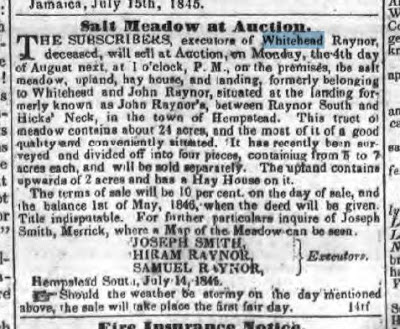
Whitehead Raynor's estate for sale, 1845

I found this on one of my favorite websites, the newspaper archives at FultonHistory.com, and thought it was so interesting - it doesn't really add anything genealogically (although it does verify some known info) but the description of Whitehead's land helps me picture a little bit what his life might have been like living there. Whitehead Raynor, by the way, is my fifth great-grandfather.

From the Long Island Farmer, July 1845:
Salt Meadow at Auction
The subscribers, executors of Whitehead Raynor, deceased, will sell at Auction on Monday, the fourth day of August, next, at 1 o'clock, P.M., on the premises, the salt meadow, upland, hay house, and landing, formerly belonging to Whitehead and John Raynor, situated at the landing formerly known as John Raynor's, between Raynor South and Hick's Neck, in the town of Hempstead. This tract of meadow contains about 24 acres, and the most of it of a good quality and conveniently situated. It has recently been surveyed and and divided off into four pieces, containing from 5 to 7 acres each, and will be sold separately. The upland contains upwards of 2 acres and has a Hay House on it.
         The terms of sale will be 10 percent on the day of sale, and the balance 1st of May, 1846, when the deed will be given. Title indisputable. For further particulars inquire of Joseph Smith, Merrick, where a Map of the Meadow can be seen.
Joseph Smith
Hiram Raynor
Samuel Raynor, Executors
Hempstead South, July 14, 1845
Should the weather be stormy on the day mentioned above, the sale will take place the first fair day.


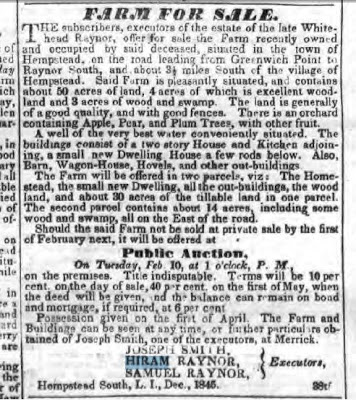
Hiram and Samuel Raynor were Whitehead's sons. Joseph Smith was his son in law. Raynor South is now the village of Freeport and Hick's Neck is now the town of Baldwin, located right next to each other. In this second one, from the Long Island Farmer, December 1845, more of Whitehead's property is being sold. Parts read: "executors of the estate of the late Whitehead Raynor, offer the Farm recently owned and occupied by said deceased, situated in the town of Hempstead, on the road leading from Greenwich Point to Raynor South, and about 3 1/2 miles South of the village of Hempstead. Said farm is pleasantly situated, and contains about 50 acres of land, 4 acres which is excellent woodland and 3 acres of wood and swamp. The land is generally of a good quality, and with good fences. There is an orchard containing Apple, Pear, and Plum trees, with other fruit. A well of the very best water conveniently situated. The buildings consist of a two story House and Kitchen adjoining, a small new Dwelling House a few rods below. Also, Barn, Wagon-House, Hovels, and other outbuildings. ...Should the said Farm not be sold at private sale by the first of February next , it will be offered at Public Auction."


Again, Raynor South is present-day Freeport, and Greenwich Point appears to have been in the vicinity of present-day Roosevelt, which is to the town right north of Freeport (if you look at the old map from 1873 here, you can see Babylon Turnpike's northernmost end, which is in Roosevelt).

But I love the descriptions - fruit trees! A well! Woodland! All these buildings dotting the landscape! Can't you just picture what it looked like? I love it! :)

If you love dead people, you're either a serial killer or a genealogist

So sayeth cousin April and I.

So, a few weeks ago already - Good Friday, I think it was, since we both had off - April and I drove up to Albany to take a look at some holdings at the New York State Archives. If you're an armchair genealogist, there's nothing wrong with that - you can find all sorts of perfectly reliable info at your fingertips on the Internet nowadays. Part of the fun for me, though, is the field trips. Even when the field trips are a bit fruitless.

April and I are each currently researching several branches of our own trees but the thing that brought us together and that we're determined to solve, is the mystery of Jacob Raynor's parents. Jacob and his wife Rebecca are our common ancestors - April is descended from their daughter Elizabeth and I am descended from their sons Joseph and James. The Raynor name is huge where we're from on Long Island because they were one of the founding families of the area, but strangely enough, we're connected to them through Rebecca (who, yes, was a Raynor before she married a Raynor - that's what happened in these colonial towns where everybody was related to everybody else!), but no one seems to know who Jacob's parents are. Two theories have been posited but no one can seem to tell me or April the basis for putting forth these possible parents - all we want is some proof of said theories. That was the purpose of our Albany trip.

An interesting but also frustrating thing about genealogy research is that while there are records that are overaching, for the most part, each locality also has its own types of records that you may not find in other places or in other years. In the course of some of her own research, April had stumbled upon something for the Town of Hempstead called the earmark register, in which people had to register the identifying marks on the ears of their cattle. What some of these entries indicate, and what can also be inferred by similarities in earmarks, is who the cattle came from - in many cases, they were inherited by sons or grandsons. If we could find Jacob as someone's son or grandson...well, that would be too easy. That would solve our whole mystery there!

Needless to say, that didn't happen. April and I sat in front of a microfilm machine for hours pouring over pages and pages of indecipherable handwriting and nowhere did we find "Jacob, son of." What we did find, however, were some possibly important clues as to who else to look at to get to the next step - sometimes you can't go back from a person, but you can go back from a sibling or another relative. We saw a lot of "James, son of Jacob"s, which could be my James, son of Jacob, though they were both common names, but two other names were starting to show a pattern - Micajah Raynor and Zebulon Smith.

Gotta love those crazy Old Testament names, huh?

Those two names kept coming up in connection to a Jacob Raynor. Micajah pinged on mine and April's radar because when we took a fruitless field trip up to Boston several months ago, April had brought an inventory of Jacob's estate from 1829 that was put together by a one Micajah Raynor. When we showed it to David Allen Lambert, a professional genealogist with the New England Historic Genealogical Society, his very first reaction, without hesitation, was that Micajah was of course Jacob's brother. Now is it possible he was just a good friend or neighbor? Of course. There were Raynors everywhere at that time. But Dave's gut was telling him something and I never, ever discredit my gut when it comes to following a lead.

Now, Zebulon Smith was NOT a name April or I had ever seen in connection to our Raynors before, but he, too, was turning up everywhere. One set of posited parents for Jacob was Joseph Raynor and Phebe Smith. Was Zebulon Smith Phebe's father? Was he Jacob's grandfather? In many unsubstantiated family trees floating around the Internet, Joseph and Phebe most often are not listed with a son Jacob. But they are listed with a son Micajah. And Zebulah (bastardized version of Zebulon Smith?)

So that's the direction April and I are heading in now. Zebulon and Micajah, unlike Jacob, seem to want to be found, very much so. Is it because they're family? Maybe. But we're thinking if we can somehow find death dates and then wills or property deeds or transactions for Zebulon and/or Micajah and/or Joseph and Phebe, maybe someone will make mention of "my brother/son/cousin/nephew/grandson Jacob...husband of Rebecca, not to be confused with the other Jacobs out there." It's extremely, extremely frustrating. But this is also the exact reason I love genealogy so much - if it wasn't as much of a mystery and a puzzle, it wouldn't be half as fun!

And just as a sidenote, if any of you out there reading this has some reliable research on Micajah Raynor, Zebulon Smith, or Joseph Raynor and Phebe Smith, hit a sister up, would ya? :)

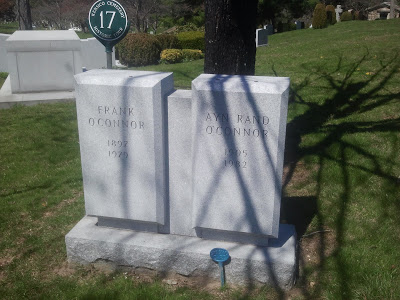
Tombstone Tuesday: Ayn Rand, Kensico Cemetery in Valhalla, NY

Cousin April and I went on a genealogy field trip to the New York State Archives in Albany on Friday to try to chip away at the mystery of Jacob Raynor's parents. It was an interesting day, which I will write about in a later post. On the way back, she wanted to stop at Kensico Cemetery in Valhalla, where some newly discovered relatives were buried. Like many of us with poor relations, they did not have a headstone, but the many people who do have these huge, unique, sometimes beautiful, sometimes ostentatious headstones and mausoleums. The place is just absolutely gorgeous. Anyway, quite a few famous people also happen to be buried there. April and I visited two of them, and I submit this photo I took of Ayn Rand's grave for this week's Tombstone Tuesday post:

Ayn Rand headstone in Kensico Cemetery, Valhalla, NY. Taken by Mary Ellen Gorry, 6 April 2012.
I'll be honest - I've never actually read any Ayn Rand novels but I am an avid reader and I know she's one of the great figures of modern literature. We also stopped to look at the grave of Lou Gehrig; I posted that photo in my sports blog here. In both cases I loved seeing how simple the headstones were of these two very famous people. I also liked seeing Ayn Rand buried with her husband, and Lou Gehrig surrounded by his family - I think sometimes we forget that even famous historical figures had families and were mothers, wives, and daughters.

Happy 97th birthday to my genealogy inspiration...

Grandma, circa 1930, with her mother, Ellen Casey Cronin.
 My grandmother, Mary Cronin Raynor, is 97 years old today and still kickin'. She started to learn genealogy as a hobby when her kids - my mother, my aunt, and my two uncles - were in school, way back when you still had to use books and write snail mail letters to distant relatives to ask them what information they know, and depend on church records and any old letters or photos or, if you were lucky, birth and death certificates that your parents or grandparents might have kept. My grandmother's family is 100 percent Irish - her dad, Timothy Ambrose Cronin, was born in Ireland, as were her maternal grandparents, Peter Casey and Mary Agnes Enright, and while Grandma did a great job of recording as much as she could find on her family from her grandparents down, what lay beyond that was always a brick wall for her - she even made a trip to Ireland to try to find her grandfather Denis Cronin's grave, but the cemetery was full of Denis Cronins, with no dates or other info on the headstones. I've had a bit more luck, finding Mary Enright's maternal grandparents, but not much more than that. My grandmother kept good notes though full of clues about cousins on her dad's side of the family, and she gave them to me, so at least I have something to work with.

My grandmother actually focused much of what she learned on my grandfather and her husband, Clifford Monroe Raynor's, side of the family. The Raynors have a lot of information out there. My grandmother recorded it all down, and she even researched his mother's side of the family, the Bergs. She wrote down who she got the information from and little anecdotes they told her as well.

After my parents got married, Grandma even went so far as to find information on my *dad's* side of the family tree - the first thing I know about my paternal grandmother, Helen Stutzmann's, side of the family is from my maternal grandmother. How cool is that?

But I got my first taste of genealogy from looking through the books of information my grandmother had put together. I was hooked even before I knew I was hooked. And as I got older and took it more seriously, I became someone she could share her research with, she loved hearing about all the new things I was discovering about the family, and genealogy became something we could always talk about.

So thank you Grandma, for inspiring me to always keep chipping away at those brick walls, and for instilling in me a passion for trying to learn who my family is and where I come from. Happy 97th birthday!

The two Marys and two genealogists.

Nancy Drew and the case of the 1940 U.S. census

The detective work has become and the first results have already come in! The period between 1930-1940 saw a lot of deaths in my family and a lot of families moving around, which can make finding their enumeration districts difficult. Lucky for me, the Raynors have deep Freeport roots. They came in the 1650s and they never left, so I know exactly where to find them!

I neglected to put in my last post where to find the census - if you're an Ancestry member, they're uploading the census images as we speak. If you're not, you can go to 1940census.archives.gov, but be forewarned - EVERYBODY is using the site and pages are loading extremely slowly, if even at all. I searched for 3rd great-grandmother, Meta Tiedemann Ricklefs, where I last saw her, in Patchogue, Suffolk County, Long Island, New York. Her husband, John Ricklefs, had died in 1937, and I couldn't find her at first glance, so she's either in the next ED over or she has died by 1940 as well. Freeport is a fairly small place, and that's where the Raynors are entrenched, so that's where I went next. The good news is, once I FINALLY got to an ED, I found that they've been broken up into manageable chunks - you only have to go through about 24 pages, at least in the EDs I've checked so far. But Randy Seaver over at Genea-Musings gave some good advice here, suggesting how to find the ED if you don't already know, and that downloading all the ED file would be a better way to look over each page, which is what I did - it was taking too long for the images to appear on my screen, but they downloaded very quickly to my computer.

I already found my grandfather, Clifford Raynor, his father, Monroe Raynor, and HIS father, Joseph J. Raynor, living on South Main Street in Freeport - the handwriting isn't so great so it's a little difficult to read some of the info, and since these are ancestors I know pretty well, there aren't too many surprises so far, but I have already found mistakes - great-great grandpa J.J.'s daughter Eliza is listed as his wife, and his daughter-in-law, Alice, is listed as a daughter and his *granddaughter* is listed as a daughter. There's supposed to be an "x" next to the name of the person who provided the information, but I haven't seen one so far. Still, I'm excited to see what else I find, but I know now that I'm going to have to perfect the art of patience over the next few weeks. Maybe I should start meditating...

1940 has arrived!

Starting today, you can look for family in the 1940 U.S. Census.

If all you've ever experienced was a nicely indexed census where all you have to do is type in the name of the person you're looking for and, voila, it appears out of thin air, then be forewarned.

This census, at least for the time being, is going to be a lot of tedious, frustrating work.

Indexing is in the works, and if you feel up to the task, volunteers are signing up every day to help with the process. I'm both excited about and dreading this day - I'm looking forward to finding out what happened to some of the individuals in my family who I last saw in 1930 - I know a lot about their early years but almost nothing about their later years. But I remember a time, not too long ago, when the 1920 census wasn't indexed, and I had to sit at my computer, for hours on end, Ancestry.com on one page, a street map of Brooklyn on the other, and try to find, based on my ancestors' addresses, the proper enumeration district, and THEN scroll through that district page by page by page by page....you get the idea. For now, that's what we're all in for. And while it's time-consuming work, in a way, I'm kind of looking forward to it, because it puts the detective aspect back into genealogy. This information is not going to be handed to you on a silver platter. You're going to have to earn it. It's going to be boring. It's going to make you want to tear your hair out. But when you find what you're looking for, boy, is it worth it!

Good luck everyone - happy hunting!

"Who Do You Think You Are?": Helen Hunt

Some of my thoughts on last week's Helen Hunt-centric episode of WDYTYA:

  • Funny that just as I wrote a blog entry saying I wanted to see some Western genealogy, this episode did a little bit of tracing Helen's San Francisco-based family, who took advantage of the 1849 Gold Rush to expand their business.
  • I kinda dug that portion of the show because Helen's ancestor became a successful and wealthy businessman who ended up investing in a bank (the eventual Wells Fargo) that is still around today. I could totally identify with this, as my great-great grandfather Rudolph Stutzmann became a successful and wealthy businessman (as an undertaker) who ended up a founding member and first president of a bank (Ridgewood Savings Bank) that is still around today. Loved it.
  • I really wanted to see more emotion on Helen's part, at least for the first three-quarters of the episode. When she was talking to the woman who had written a book on her own San Francisco-based genealogy and it turned out that their ancestors had been friends and business partners, I just loved it, and yet Helen was all, "meh." She really didn't seem like she wanted to be there and she really, really didn't seem excited about anything she was finding out (except that her ancestors were rich, and that kind of bothered me, too). But I was getting more excited than her, and it wasn't even my family they were talking about!
  • I loved the last part of the episode, when Helen traveled to Maine to learn about her great-grandmother Augusta Hunt. That was where Helen seemed to finally emotionally connect to a specific person in her tree and to her ancestry in general. The irony of Helen's great-grandmother fighting alcohol abuse and her future daughter-in-law being killed by a drunk driver really seemed to resonate with her, as well as finding out her great-grandmother was instrumental in the fight for women's suffrage and that she lived to be able to register to vote and be the first woman to cast a ballot in Maine. That was really cool.
  • I loved that Helen was able to read the keynote speech her great-grandmother wrote and gave at one of the meetings. I've read newspaper articles where my great-great grandfather Rudolph has been quoted, and more than vital records and obits and census records, these things are an actual voice from the past - these are words your ancestor spoke, these are thoughts they actually had, reaching out over the years, the decades, the centuries, to us today, a tiny glimpse into their personality, their psyche, their lives. I just love that.
Overall, I would say that I really wanted to throttle Helen for the first part of this episode for not realizing how immensely cool this all is, but by the end of the episode, it was probably my favorite one so far this season...and of course, I was crying. Well played, show.

Next up this week (tomorrow): Rita Wilson explores her Bulgarian roots, answering another thing on my wishlist, seeing more Eastern European genealogy. 

Tombstone Tuesday: Rodney Dangerfield

Tombstone Tuesday always makes me think of my dad because a love of cemeteries and headstones is something we share. He said his dad also liked them, so that's right there is three generations of weirdos. I joke, but I really did not realize how strange my fascination with cemeteries was to other people until recently, because I could talk about them with my dad like it was normal. We'd even go on cemetery field trips together. Anyway, now Tombstone Tuesday always makes him think of me and he'll send me photos of some of his favorite headstones, some of them belonging to relatives, some of them not. Here's this week's offering: comedian Rodney Dangerfield, who died in 2004 and is buried in Westwood Village Memorial Park Cemetery in Los Angeles. The inscription under his name always makes me laugh.

Most cemeteries could use a little humor. :)


May the road rise up to meet you...

Today I'd like to take a moment to just remember my Irish family members, some of whom fled Ireland to escape the Great Hunger in the mid-1800s, many of whom emigrated years later, all of whom were well established in New York by the turn of the 20th century. St. Patrick's Day is an Irish holiday, but it's also a very New York-Irish holiday. I'm a bit of a mutt, but my biggest ancestry percentage, at 50 percent, is Irish - my paternal grandfather, Elmer Gorry, was 100 percent Irish, as is my maternal grandmother, Mary Cronin Raynor. Grandpa's great-great-great grandparents were both potato famine era Irish immigrants, settling in the Lower East Side of New York City: James Gorry from County Meath and Mary Corr, who came from County Cavan with her mother and two brothers. And Grandma's father, Timothy Cronin, came to Brooklyn from County Cork with his mom and brothers and sisters in th 1880s. When I was in third grade, we were talking in class about things that aren't real and one of my classmates mentioned leprechauns. I was hardly one to participate in class, but my hand immediately shot up so I could correct her - leprechauns ARE real, and I know for a fact, because my grandmother told me that her father told her he had seen one when he was a boy in Ireland.

To this day, I'm not sure he was joking...

And in between the Gorrys and Cronins, we had Tormeys and Horgans and Murphys and Prendergasts and Enrights who left Ireland for New York, and lets not forget all the Donnellys and Collins and Donoghues and Cullinanes who they also came from. I don't identify as much with my Irish side anymore, but I'm very proud to be of Irish descent. They are the hardest family for me to trace and I'll probably never be able to go back much further than my immigrant ancestors, but I always think of them anyway - whenever I think of me and my siblings with our Irish first names, or see my sister with her red hair, or when I misplace something and I know, I just know, that a leprechaun took it.

Happy St. Patrick's Day!

"Who Do You Think You Are?": Jerome Bettis

Like how I'm waiting a whole week to post about these episodes? Way to stay current...

I actually don't have that many thoughts about this episode of WDYTYA. Two things in particular struck me, one good and one bad: when Jerome Bettis discovered his great-grandfather had abandoned his wife and young children, and that's why his grandfather didn't know much about him or never really talked about him, it was a little heartbreaking. It started out like Kim Cattrall's search for her grandfather, which didn't have a happy ending. But then Bettis searched for his great-grandfather's early history and discovered that he had pressed charges against his (white) boss in the Jim Crow south and brought him to court and - poof! - like magic, the guy was no longer a scoundrel, he was a hero. That disturbed me a little, that Bettis so quickly and easily forgot or chose to ignore that this man, while yes, was brave in standing up for himself in his youth, grew up to be a man who completely abandoned his family. Bettis kept saying how proud he was of him and that kind of bothered me.

What didn't bother me was his great-grandfather's father's story of not only taking a giant railroad company to court for injuries he incurred on their property, but for the case going in his favor, despite the all-white jury. That was impressive - that he had the courage to embrace that David and Goliath fight, but also that he got a fair trial. Yes, there was a lot of racism and hate and segregation and ignorance and all that jazz, but people forget (like Bettis seemed to) that there were also a lot of people who believed in equality, and even if they didn't necessarily believe in equality, they believed in fairness and justice.

Anyway, this episode kind of made me realize that while the original series has been broadcasting in the UK for years, that after awhile, the episodes start to feel repetitive. Unless it's a celebrity you're particularly interested in or like, or there's a real unique angle, the nuts and bolts of everyone's family story are the same. Although I guess you don't really know what surprises or unique angles you're going to find until you already start looking.

 I'd like to see some diversity in the storytelling - except for Sarah Jessica Parker, we haven't really seen anybody trace their family west of the Mississippi River; if I'm correct we haven't really seen any Eastern European genealogy except for Lisa Kudrow. What about all those Canadian and Australian actors out there? I'd love to see some Canadian and Australian genealogy. And I know this would be much more work for the researchers and possibly not fiscally feasible given the number of staff and time restrictions, but what about branching out from the white/black divide to our Central/South American and Asian brothers and sisters? These are the things I think about when I'm at work...

There's no new episode tonight, so don't sit there looking for it...go out and get a head start on celebrating St. Patrick's Day! I am half Irish by blood, but as I always say, we're all Irish on St. Patrick's Day! ;)

Enjoy your weekend, everyone!

"Who Do You Think You Are?": Reba McEntire

Though I didn't love this episode - for some reason, it felt really light on the whole "going on a journey to solve a family mystery/make a discovery" thing - two things stood out for me in the Reba McEntire episode last Friday of WDYTYA.

The first was the realization that just as it must be devastating for African-Americans to come face-to-face with the reality that they have ancestors who were slaves, it must not be a picnic for white Americans to realize they had ancestors who were slaveholders. My family has been here for hundreds of years but because they were concentrated in New York/New England, that hasn't ever been an issue for me (although its entirely possible that even in the north I had family who owned slaves - I just haven't found any records of it yet). But Reba seemed absolutely heartbroken when she came across that record for George Brasfield. So while I imagine it has to be harder to know your ancestors were slaves, it was interesting angle to see that it can be a struggle on both sides of it to come to terms with this shameful part of our history.

I also always find it interesting to see which ancestor a person ends up identifying with and Reba, as a mother, really seemed to struggle with the fact that the other George Brasfield, the first on her side of the family to come to America, came here as a 10 year old indentured servant. Since she couldn't imagine ever sending her son on a dangerous voyage across the ocean, knowing she would never see him again, she really needed to find out why that happened. There are all sorts of reasons we identify with certain ancestors, whether its because we are in a similar situation in life or we have similar personalities, but I also appreciate anybody who after undertaking this journey, needs to know not just the who, what, when, and where, but also the why, because without the why, the rest is kind of meaningless. But I actually identified with Reba and George Brasfield the Senior in this episode because I have a similar ancestral story, in that my first Raynor in this country, Edward, was only 10 years old when he came here in 1634. He was an orphan, but he had the advantage that at least he didn't come alone - he traveled here with his uncle and his cousins. But I still always wonder what it must have been like to be uprooted from your life at 10 to undertake a dangerous sea voyage to a completely unknown wilderness. That has always fascinated me.

So looking back at what I wrote, I guess it turns out that even when these episodes don't really speak to me...they still kinda do!