Tombstone Tuesday - Elijah and Elizabeth Sprague @ Greenfield Cemetery, Uniondale, NY

Elijah and  Elizabeth Sprague and an unknown Emma Sprague at Greenfield Cemetery in Uniondale, New York

Elijah and Elizabeth Sprague are my 5th great grandparents on my mom's side of the family. Their daughter, Elmira, married James Raynor, and they are my 4th great grandparents. So many of my ancestors are buried in Greenfield, some because it's just local, and others because they were originally buried in Freeport, but that cemetery was built over and all the bodies moved to Greenfield, two towns up. I didn't know Elijah and Elizabeth were there, although I should have assumed. I went there on my lunch break a few months ago to take photos of and visit the Raynor, Berg, and Dauch family plots and once I was done with that, I decided to wander around, as I am wont to do when I'm in a cemetery. Sometimes I'm looking for interesting headstones, but in Greenfield in particular, I'm looking at and recognizing almost every single name from my genealogy research-by marriage and through other branches, I feel like I'm related to everybody in there!

Anyway, I stumbled upon these headstones by accident. Or maybe the universe drew me to that place so I could finally "meet" these relatives I had so far only known through census records. Elijah's headstone reads, "In memory of Elijah Sprague who died Dec. 31, 1858 aged 80 years, 9 mos, & 13 days."

Right next to him is Elizabeth (they say she's a Smith, but I've never been able to verify that or connect her to any Long Island branch of the Smith family), and her headstone reads,"In memory of Elizabeth, wife of Elijah Sprague who died March 29, 1859 aged 80 years, 10 months, & 26 days."

Next to them is a third headstone for an Emma J. Sprague, and to be honest, I'm not quite sure who it is. I was just checking and I don't have an Emma Sprague in my records, but maybe it's a grandchild of theirs, based on the dates? That headstone reads, "In memory of Emma J. Sprague died Dec. 18, 1885, aged 16 years, 8 months & 16 days."

Military Monday - Charles Haase muster rolls

In case you haven't noticed, most of my military records belong to Charles Haase. While my grandfathers and great grandfathers also served in the military, I don't have a lot of records for them, and Charles is the only one I know of who actually served in a war (the American Civil War). So anyway, here goes again with ole' Charles...

I sent away for these records to the National Archives in Washington, D.C. Getting records from there, depending on what you ask for, can be pricey, but they have a lot of good stuff archived and the records usually get shipped pretty quickly.

I wanted Charles Haase's muster roll records because I had the date he enlisted in the Army, and the date he was discharged, but I was curious as to where he spent his time in between (it was less than a year that he served). I know his unit took part in General Sherman's March to Sea, but as I've learned from my research, unless you're so lucky that you have a muster roll for an actual date of a battle, you really can't say for certain what aspects of the war your ancestor took part in. Of course, a muster roll does give you a general vicinity in which that person was at that time, so if your ancestor was recorded as being in New Jersey in October of 1864 then you can be fairly certain he wasn't part of, say, the siege of Atlanta.

The muster rolls are somewhat informative - if I hadn't known for example that Charles was a hatter by trade, I would have found out from these records. It can also give a description of the individual, his possessions, what he owed, etc.

I have one muster roll for Company H of the 33rd New Jersey Infantry: "Charles Haase appears with rank of private...roll dated Trenton, N.J., Oct. 23, 1864." It says he was born in Germany, is age 35, occupation hatter. Drafted and mustered in Sept. 22, 1864, Newark, N.J. for a period of one year. His eyes are blue, hair is light, complexion is dark, and he stands 5'7".

One one roll he's charged 8 cents for a cartridge box plate and "also 23 cents for screwdriver." On June 1, 1865 he was present in Bladensburg, Maryland, which is when and where he mustered out. He had drawn $72.77 from his clothing account. On July 17, 1865 he was in Washington, D.C. where he still owed money for his clothes. In another, it says he was drafted out of Union township in New Jersey.

Even if these records don't tell you anything new, the fact that they're repeating the same information you already know helps to corroborate the information you have. The more you can back up your research, the more accurate it probably is.


You can find the National Archives at www.archives.gov.

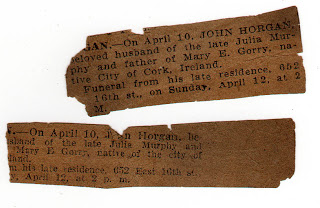
Sunday's Obituary - John Horgan

"HORGAN - On April 10, John Horgan, beloved husband of the late Julia Murphy and father of Mary E. Gorry, native City of Cork, Ireland. Funeral from his late residence, 652 East 16th st., on Sunday, April 12, at 2 p.m."

Ah, Irish Catholics. Not only do we love reading obituaries, but we love clipping and keeping them.

John Horgan was my 3rd great grandfather and I know very little about him besides the information in this obituary, which is actually a pretty informative obit - place of birth, wife's maiden name, address. I had to use information in this obit (such as the day of the week the dates fell on) and info from the back of this clipping (a headline for a boxing match) to determine what year John Horgan died. I now also have a death certificate for him and a ship passenger list with his name on it, but between his arrival to New York in 1871 and his death here in 1908, I have almost no information about him - I have a mid 20th century record of him as the father at his daughter Mary's baptism, but I can't find him on a census, city directory, military record, marriage certificate, naturalization record, etc. nada, nothing. John and Julia are two of my most frustrating, mysterious ancestors, but I'm still working on "finding" them somewhere in that almost 40 year gap - they can't be complete ghosts, right?

Funeral Card Friday - a family hobby

This is actually a topic that is near and dear to my heart, as it seems Irish Catholics in particular have an obsession with, besides reading the obituaries, collecting funeral cards. I was about to call out my grandparents for this somewhat morbid hobby when I glanced at the wall of my cubicle and realized I have not one, not two, but three funeral cards pinned there. And I know I have one on my dresser at home. And another one on top of my bookcase on the other side of my room...

Macabre? Maybe. But extremely informative. Date of death. Sometimes a date of birth. Sometimes a photo. Usually the name of a funeral home, which can be a clue as to where a person died. Of course, if your relatives collect funeral cards like normal people collect baseball cards, you may have to sift through the family friends and neighbors and co-workers and complete strangers to find the ones that belong to actual relations of yours, but they're definitely helpful tools in your genealogical pursuits.


Michael Gorry was my great-great grandfather James' older brother. He was in his 70s when he died in 1933. He never married, and lived in Brooklyn with his and James' two sisters, Hannah and Mary. After James died in 1897 at the age of 28, his widow Mary Horgan didn't remarry, so while she worked for a living in Manhattan, she sent her son Elmer Anthony, my great-grandfather, to live with his spinster aunts Hannah and Mary and bachelor uncle, Michael, in Brooklyn, where they pretty much raised him. Hannah, Mary, and Michael never had any children of their own, which is why something like this funeral card is important - they might not have any descendents to remember them, but it helps me remember them and the huge role they played in forming the kind of person my great-grandfather became, which in even just a small way is helping to form the kind of person I'm becoming.

What's the story, Grandpa Gorry? At work for NBC with JFK


My grandfather, Elmer Gorry, worked at the National Broadcasting Company (NBC) for quite a few years (Dad, if you're reading this, feel free to chime in with exactly how many if you want!) During that time he had a lot of different position titles and worked on a wide variety of shows, met a lot of people, saw a lot of things, some of which I'm still learning about from my father. This is a photo that came from my grandfather's house that's been sitting in my living room for I guess what must be four years already. The back reads: "Taken March 28, 1961 in the President's Cabinet room for the JFK Show." That was two months after John F. Kennedy took office as President of the United States. He's obviously the one sitting behind the desk on the left. My grandfather is standing in the back, second from right. This is just one example that reiterates how the people in our family trees aren't just names and dates - they're talents and emotions and experiences, situated in a time and place in history.

One man's junk is another man's treasure...

My grandfather, Elmer Anthony Gorry Jr., died four years ago, yet somehow we're still sifting through the "junk" he left behind in his house. Obviously, I don't consider it junk. My grandfather was quite a pack rat, though, and he saved, probably literally, everything. My father inherited that trait from him, which is why we've still got most of this stuff in our garage. I admit that I, too, inherited the pack rat Gorry gene, which I often try to keep under control but which always breaks through around old family stuff.

If you love genealogy, you have to love the pack rats in your family, because while photos and vital records and the obvious stuff are all things you want to hold onto for future generations, it takes the true pack rat eye and mentality to realize that almost everything can have genealogical value for future generations. So while my father rather rightly finally threw away some real junk my grandfather had held on to, I'm thankful for all the helpful things we did find after my grandfather died. In fact, it was the funeral cards and funeral bills and clipped obits and letters my grandfather held on to that really got me started on the right road researching his side of the family - without them, I wouldn't even have known where to start, and so much of it helps to round out the story of the people the Gorrys (and forebears) were. So since I've been sifting through his "junk" lately, I'll be posting every now and then about the stuff we have now because he saved it for fifty-odd years, as a thank you to my very own pack rat and as a reminder to you to talk to your own family pack rats to see what kind of "junk" you can find amongst their junk.

Wordless Wednesday - "Onkie" Dan Horgan

From my grandfather's house, scrawled on the back says "Onkie Dan Horgan."

Probably a relative of great great grandma Mary Horgan Gorry's and her father John Horgan - possibly an uncle ("onkie") of one or the other? The Horgans are still very much a mystery to me, including this unknown relation...

A little bit of old school genealogy: More fun with newspapers. And libraries.

Just as an example of how popular researching one's family tree has become, the Patchogue-Medford Library out in Suffolk County, Long Island, has a whole page on their website devoted to the genealogy books and databases and other resources available inside their building.

http://www.pmlib.org/genealogy

A couple of their links are for newspaper databases on the web, available from anywhere. So, if you have New York City or Long Island ancestry from the late 19th to early 20th century, you may want to check these sites out. I had so much fun with them last night that I stayed up waaay later than I should have. But that's what happens when you're a genealogy addict, I guess. Oh, and was able to find the obit in The Mid-Island Mail that cousin Claudia mentioned for John Ricklefs. Now to shoot an e-mail to the Patchogue town clerk to see if she's the person I ask to try to find his death certicate for me. Anyway, enjoy!

http://www.suffolkhistoricnewspapers.org/

http://eagle.brooklynpubliclibrary.org/Default/Skins/BEagle/Client.asp?Skin=BEagle&AW=1285094521031&AppName=2&GZ=T

Schlegel's American Families of German Ancestry

Before I knew anything at all about my father's side of the family, before I had done any research on my own, I had my grandmother's binder of information and research she had gathered over the years, and even though she is my mother's mother, I think she realized, as any true genealogist does, the importance of knowing all sides of the story, not just your own, and so she was the first person to research my father's family tree. In that great big binder full of Raynors and Dauchs and Bergs and Cronins and Caseys, four handwritten, photocopied pages were stuck in the back, devoted to my father's mother's family, the Stutzmanns.

So that was that, for awhile. I didn't look into it further, I didn't wonder where the information had come from, and even once I started doing genealogy more seriously, I kind of forgot that those four pages were there. Eventually I noticed that my grandmother had also copied a title page, which said those pages had come from something called Schlegel's German-American Families in the United States. An internet search revealed that this was a four-volume compendium published by the American Historical Society between 1916 and 1926, and so, just so I would have an original source and not just those photocopies and also in case my family research turned up my relation to any of the other families mentioned in the books, I ordered my own copies, which are now part of my genealogy research collection at home.

As it turns out, the genealogies in it are not entirely accurate - I found a few discrepencies when I went to verify the info on my own. But it's fairly accurate and it gave me quite a detailed place to start my Stutzmann research, from the name of the town in Germany that they hailed from to great great grandpa Rudolph's rise to one of the most prominent German-Americans in early 20th century Ridgewood. I highly recommend these volumes for anyone researching their 19th century German-American roots. This is what the review on Amazon.com has to say about the compendium (including the names of families covered in the volumes):

"Of all the information-rich sources of German-American ancestry, none is this comprehensive or as useful to the researcher, as illustrated by its coverage of the following families:

Ackermann, Aichmann, Altenbrand, Ammann, Auer, Barkhausen, Bauer, Baumann, Becker, Bender, Bermel, Biertuempfel, Boos, Bossert, Brandis, Braunstein, Breidt, Broking, Burger, Cordts, Cronau, Dangler, Dannenhoffer, de Kalb, Deck, Dippel, Dittenhoefer, Dochtermann, Dornhoefer, Doscher, Draesel, Dreier, Dressel, Drewes, Dreyer, Eichacker, Eichhorn, Eimer, Engelhardt, Espenscheid, Faber, Faller, Fink, Fischer, Flammer, Focht-Vogt, Frank, Frey, Fritz, Froeb, Funk, Gaus, Gobel, Goebel, Goepel, Golsner, Grell, Gretsch, Groborsch, Gunther, Hauenstein, Haug, Haupt, Haussling, Havemeyer, Hechtenberg, Hecker, Helwig, Hering, Herkimer, Herlich, Herrmann, Hoecker, Hoffmann, Jaeckle, Jahn, Janson, Junge, Just, Katz, Keene, Kern, Kessler, Kiefer, Kircher, Kirsch, Kleinert, Kline, Kny, Kobbe, Kochersberger, Koelble, Komitsch, Korth, Kost, Koster, Kraemer, Kramer, Kroeger, Kuhn, Lafrentz, Lamprecht, Lausecker, Leisler, Lexow, Liebmann, Limbacher, Lohse, Lotz, Luckhardt, Luhrsen, Lutz, Marquardt, Martin, Maulbeck, Maurer, Meeker, Mehlin, Mende, Meurer, Meyer, Mielke, Mietz, Moeller, Moser, Mueller, Muhlenberg, Muller, Naeher, Nissen, Nungesser, Oberglock, Offermann, Otto, Pedersen, Peter, Pflug, Poppenhusen, Prahl, Rasch, Rath, Reichhelm, Reisinger, Reppenhagen, Reuter, Ridder, Riedman, Ries, Ringler, Roehr, Runkel, Ruoff, Sauerwein, Schaeffer, Schalck, Schering, Scherrer, Schieren, Schill, Schilling, Schissel, Schlegel, Schlitz, Schmelzer, Schmidt, Schmieder, Schneider, Scholzel, Schortau, Schrader, Schroeder, Schultz, Schumann, Schurz, Schwarz, Sebold, Seyfarth, Sigel, Solms, Specht, Spengler, Stadler, Steiger, Steil, Steingut, Steinway, Stemme, Stengel, Steubner, Steurer, Stiefel, Stier, Stohn, Strebel, Stuber, Stutz, Stutzmann, Sutro, Thumann, Vogeler, Vollweiler, vom Hofe, von Bernuth, von Briesen, von Steuben, Wahlers, Weber, Weimar, Weismann, Weitling, Wendel, Wenk, Wesel, Wilhelms, Wintjen, Wischmann, Wolffram, Zaabel, Zechiel, and Zobel

This is a reprint of the largest collection of German-American genealogies ever published, a full-blown compendium of family history and biography unknown to all but a handful of specialists. The first three volumes were published somewhat inopportunely between 1916 and 1918, with a fourth volume added in 1926. Each volume was limited to 200 numbered and registered copies, and consequently only a dozen or so three-volume sets can be located today, while the fourth volume is all but unknown. This is a complete paradox, for like similar compendia by Virkus and McKenzie, this work should be available to all students of genealogy and should be the very first resource for anyone researching German-American ancestry.

Unlike other great compendia, however, Schlegel doesn't just start out with the immigrant ancestor; rather, each family history usually begins two or three generations back, examining the family in its historic setting before bringing it forward to the immigrant ancestor and his descendants in America. Averaging about ten pages in length, including portraits and coats of arms, the family histories are no mere catalogs of births, marriages, and deaths but are rich biographical and genealogical studies, each depicting the education, service, achievements, life, and career of the various family members, and each tracing the roots of the first four or five generations in America, usually commencing in the 18th or the 19th century, naming thousands of related family members."

Military Monday - Charles Haase's Civil War army discharge


Thanks to cousin Milton for this document. A transcription of the document text is:


Know that Charles Haase a Private of Capt Barent Frazer Jr Company H 33rd Regiment of New Jersey Volunteers who was enrolled on the 22 day of September one thousand eight hundred and Sixty Four to serve One year during the war is hereby DISCHARGED from the service of the United States this First day of June 1865, at Bladensburg, MD In compliance with General Order No 77, War Dept. C.S. No objection to his being reenlisted is known to exist.
Said Charles Haase was born in Germany in the state of ____, is 25 years of age 5 feet 7 inches high, dark complexion, Blue eyes Light hair and his occupation when he enrolled, a Hatter.
Given at BLADENSBURG, MD 1865
Signed
Capt R. H. Wilbur
Captain of the 102nd Regiment, NY Volunteers

Ancestor profile: The mystery of Hiram Horatio Raynor...

Hiram Horatio Raynor is my third great grandfather on my mother's side of the family. He's buried in a plot in Greenfield Cemetery, Uniondale, Long Island, New York along with his wife, Ann (Raynor) Raynor, their son and daughter-in-law, Joseph J. "J.J." Raynor and Annie (Poole) Raynor, and J.J. and Annie's three children - William Poole Raynor, Eliza "Lidie" Raynor, and Monroe Raynor (my great-grandfather) and Monroe's wife, Amelia Berg Raynor (my great-grandmother). Hiram's headstone reads, "Hiram H. Raynor, died Dec. 18, 1898" and his age puts his birth about Dec. 24, 1824.

His parents were Joseph and Elizabeth, who died in 1829 and 1828, respectively. Now, I personally have not been able to verify that particular information. That's based on research done by other Raynors before me, so we take that with a grain of salt, although there is evidence, both real and circumstantial, linking him to both Rebecca Raynor (Joseph's mother) and Whitehead Raynor (Elizabeth's father).

In my records, and as far as I can tell, everyone else's records, Hiram disappears, from his birth until 1855. He should appear in the 1850 census, but I can't find him, despite extensive and exhaustive looking. I even looked under the name "Hiram Horatio Smith" on the theory that it's possible Joseph's sister Elizabeth and her husband, Uriah Smith, took him in as a child after the deaths of his parents. I arrived at this possibility due to inaccurate information on the Long Island Genealogy website (which gives a good place to start looking but which is shamefully, embarrassingly inaccurate) that listed a Hiram Horatio Smith, born 1824, as one of the children of Elizabeth and Uriah. That theory so far has not panned out, and neither has the one that Hiram H. Raynor left Long Island as a young adult and traveled somewhere else for awhile before returning home, but I haven't given up yet that I'll find him there, although he may turn out to be an 1850 census ghost - I have a lot of relatives who are, frustratingly, census ghosts...

So, we don't have Hiram in the 1850 census, but we do have him in the 1860, married to Ann with son Joseph, as well as the 1870 and 1880. In all three he's living in Hempstead, Long Island - listed as a seaman in 1860, a bayman in 1870, and an oyster planter in 1880, which is how many of the residents living on the water in those times made a living...So far I haven't been able to find him in the 1892 New York State census, either, but I've only just started looking for him there. You have to be patient and persistent when it comes to these things. I am neither patient nor persistent, so genealogy, in addition to being fun, is teaching me to be both those things...

But, you ask, didn't I say that Hiram appears on records before the 1860 census, in 1855? He does indeed, and I thank cousin April E., for sharing with me these documents that she found. In October of 1855, Hiram H. Raynor was made one of the executors of his grandmother Rebecca Raynor's estate. The beginning of the one document reads, "The people of the State of New York, to Jacob Raynor, son of Rebecca Raynor, deceased, and Hiram H. Raynor, grandson of said Rebecca Raynor, deceased, send greeting."

So, that's pretty interesting. The inventory of Rebecca's estate gives you some insight into her life, but sometimes we forget to look at the other names on the document, such as her grandson Hiram and his uncle Jacob...and looking at those names places my third great grandfather five years earlier than the 1860 census does, but there's still a 30 year gap that I would love to somehow, some way, eventually narrow down and/or account for. Also, I would love to know where his middle name came from. It sounds like something straight out of Shakespeare, right?

I don't have any photos of Hiram but I visit his grave at Greenfield sometimes, just to say hi and see if maybe he'd like to give me some insight into where to look for him next.

Hiram Horatio Raynor's headstone is on the left, next to the grave of his grandson, William Poole Raynor.


And, awesomely enough, thanks to April, I also have my third great grandfather's signature...it's the little things that make me happy. :)

Newspapers: a glimpse into the daily lives of our ancestors

In most cases, I think newspaper stories related to our ancestors are limited to birth, marriage, and death announcements. But every now and then you get the juicy, scandalous story of a bank-robbing relative. And every now and then you get family who lived in a small, suburban/rural town where the local paper covered the mundane, daily activities of the local citizenry, and while for the general public these minutiae might not be interesting, for the genealogist, it can give a very real, full picture of what every day life was like for your ancestors - selling property, going to work, going to parties, visiting friends, getting sick, serving on juries, adding on to their homes, doing well in school, just living life, the way we all do every day.

Ancestry.com has a large selection of newspapers indexed on their site. For me, http://www.fultonhistory.com/ is more useful because most of the newspapers are for the New York City/Long Island region, although it also has an extensive upstate collection as well as a few papers from the rest of the United States. But also don't forget your local library - many of them have old, local newspapers available for you to look at. And it's the small, local newspapers that are going to be your best bet to find information on any of your relatives who never really made it to the national spotlight :). Oh, and it's also fun to look at old ads for products that are no longer in existence or to see how ridiculously cheap everything used to be...

Here are just a few examples of what I've found on my own family:

From The Long Islander:
Friday, August 17, 1917 - Under Hicksville news: "Allan Dauch, who is employed with the General Electric Company at Schenectady, N.Y. is spending a two week vacation at the home of his parents, Mr. and Mrs. Adam L. Dauch."

Friday, February 23, 1912 - Under Hicksville news: "Mr. and Mrs. John Dauch, old residents of this village, celebrated their golden wedding at their home Sunday afternoon and evening, February 18, in the presence of their six children, five grandchildren, and several intimate friends of the family. At 5 o'clock supper was served in their spacious drawing room, which was elaborately decorated with carnations, ferns, and palms, the tone of the room being golden yellow. The celebrating couple received many beautiful gifts of china and gold..."

Friday, January 5, 1906 - Under Hicksville news: "John Dauch while cutting wood recently made a miss and chopped off part of his finger."

Friday, June 26, 1930 - Under Hicksville news: "The Dauch homestead on Cherry Street has received a fresh coat of paint."

Friday, December 7, 1917 - Under Hicksville news: "A very enjoyable time was spent at the home of Mr. and Mrs. A.L. Dauch on Friday evening. The hours were passed in games and music. A splendid luncheon was served, the table being decorated  with red, white, and blue."

From The Brooklyn Daily Eagle:

Sunday, January 6, 1918 - "Mr. and Mrs. Theodore P. Berg of Hempstead, L.I. are located here for the season after a pleasant motor trip from Jacksonville."

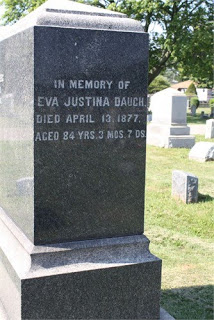
Tombstone Tuesday - Eva Justina Hoerner Dauch


Eva Justina Dauch, my fourth-great grandmother, died April 13, 1877, and is buried in Greenfield Cemetery, Uniondale, Long Island, New York, in a plot bought by her grandson-in-law, Theodore Peterson Berg (my great-great grandfather). According to the headstone, she was 84 years, 3 months, and 7 days old.

I don't know much about her. I know her death was listed in the Queens County Sentinel, a now-defunct newspaper. I know that according to a ship passenger list, she arrived in New York harbor aboard the Leila on Sept. 22, 1845 from Le Havre, France with her husband Nicolas, 46, and three of their children - Andreas (Andrew), 19; Thomas, 16; and Marie (Mary), 9. They were all born in Bavaria according to the list. I know she and her family disappear for 25 years after that - I can't find her in the 1850 or the 1860 U.S. census - and when she reappears, her husband is dead and she is living near her son Thomas in Hempstead, Long Island, and with her daughter, now Mary Gasser, and she is listed in the census as "Christina Dowe" (The Justina in her name sometimes gets switched to Christina and the "Dauch" last name is actually pronounced "Dow" and so often got spelled that way...). I know that she is one of those Germans who had extra first names she probably didn't use - I think on her death certificate, she's listed as "Mary."

But for the most part, she's still a mystery to me. I don't know why she left Germany, and if one of my distant relatives is correct in his research, why she left some of her children behind when she did. I don't know where she went during those missing 25 years between her arrival in Manhattan and her appearance in the 1870 census.

An All-American girl...

So as we all know, I'm a mutt. I'm half Irish, a third German, a tad Danish, and the rest a mad mix o' ethnicity by way of England. Lots of Americans *are* mutts. That's part of the whole "melting pot" mentality. But, at least here in New York, we also have a lot of, for lack of a better term, "purebred" ethnicities, recent immigrants who have just come to this country. My best friend is a first generation American of Dominican descent. My boyfriend is a first generation American of Honduran descent (though, he's also more of a mutt than most Latinos, but that's a story for another day). For those who aren't first generation Americans here in the tri-state area, many of European descent are second generation Americans - I'm thinking specifically of Italian-Americans, like my good friend Suzy C. The point I'm trying to make is that I tell people I'm Irish-German-Danish-English, and maybe that explains where I get my hair, eye, or skin color, but for me, when it comes down to it, I'm All-American, and that actually makes me sad. My best friend and boyfriend speak Spanish and eat foods from their parents' homelands and dance dances from their cultures.  My good friend Suzy C. is thoroughly steeped in her Italian heritage. She goes back to Italy regularly to visit her second and third cousins who live there. My visible ties to my heritage are weak at best, which might explain why researching my family tree and learning about my heritage are so important to me. My most recent immigrant ancestor, generation-wise, is Timothy Ambrose Cronin, my maternal grandmother's father, from Cork, Ireland. I'm not sure he passed along anything of his heritage to his family (men, right?), except for the legend that he once saw a leprechaun. My most recent immigrant ancestor, year-wise, is my great-great grandmother on my dad's side of the family, Augusta Lindemann Stutzmann, who was born in Germany. Both were here by the turn of the 20th century, enough time for Old World traditions to pretty much fall by the wayside. I feel like, culture-wise, my German heritage has been passed along to me the most successfully, mostly in terms of food, mostly through my father through his mother. But I almost feel weird telling people I consider myself part Danish and part English, too, because Peter Hansen Berg came here before 1845 and Edward Raynor was here by 1634. English colonial ancestry? Celebrating the 350th anniversary of the village your ancestor founded? You don't get more American than that.

I love that I can trace my tree that far back *because* my family has been here for that long, but sometimes I do feel like I'm missing visible, tangible ties to my past because I don't know any German recipes and I can't sing any Irish folk tunes. But I think, on the other hand, that's why I encourage that kind of cultural passing-on of the baton in my friends. My mother once mentioned to me, in passing, that she was sorry she never made me and my siblings do Irish step dancing. I like that Dania and Sam can speak Spanish, and I hope they teach it to their kids. I like that Suzy and her family cook the same Italian food their parents and grandparents made, and I know Suzy will do it with her kids, too. Especially for cultures where vital records might not be as readily available as they are in the United States (where I've lucked out), like in the Dominican Republic or Honduras or even Italy, being able to pass on something to the next generation that shows where you come from (where they've lucked out) is just as valuable, I think...

Genealogy in the age of the Internet and social networking sites

When I hit brick walls tracing my family back, I amuse myself by tracing my family to the sides. Finding cousins on parallel branches opens up new research avenues - connecting with them allows you to pool your collective information. If your great-grandmother had a family Bible with a listing of birthdates that she didn't hand down to your grandfather, the children of your grandfather's sister might have it in their possession. A cousin several times removed who tracked me down had in his possession the only known photo of my 4th great-grandmother, Barbara Reinhardt Haase, which he shared with me. I never would have known what she looked like (a good, strong German woman who could have easily been a linebacker in the NFL, by the way) if there had been no sideways family tree research done.

When you trace your family to the side, you end up finding your contemporaries - not just your cousins, but your second cousins, and third cousins and fourth cousins as well.
Alumni updates, obits, social networking sites, blogs - these are all online sources of finding cousins and "getting to know them" even though they might not know you exist and you might not ever meet them. Some people might call this "internet stalking." I call it finding out the things we have in common with each other and discovering some amazing people you can call "family." On the blog front, I've found a few - one cousin writes a wonderful blog about her and her husband's journey adopting children from abroad, many with special needs, another wrote well written articles about her decisions to court rather than date, and yet another, who is Mormon, writes about the adventures she has as a missionary in Asia.

So another thing I've learned is that writers also run in my family, apparently.

I've found distant cousins who I know only by name and family line on sites such as MySpace and Facebook - one of them posted "movies" he and his brothers had made, which is interesting because directing and editing short films is something my own brother has been known to dabble in.

And of course, people have family websites, where you can find family tree information not only going backward, but going forward, too, as people announce their weddings and the births of children or grandchildren, helping you fill out the ever expanding sideways branches as well.

Taking the first steps on the road to certification...

"Why don't you do this for a living? What do you have to do to become a professional genealogist?"

That's what the ever-persistant Samuel has been asking me the past couple of months and I finally relented and sent away for the application packet for the Board for Certification of Genealogists because the truth is, I love doing this. It goes beyond a hobby for me. When I don't have anything to research on my own family line, I trace my friends' families. When I get stuck on theirs, I pick a celebrity or some famous figure to look into. I love doing it, and even though I'm still learning new things every day about how to do it better, I think I have a knack for it. I have good instincts about leads. I get feelings about information I can't yet prove, but when I do prove it, I was usually right. (Not to brag! Lol...)

Anyway, where was I going with this? Oh right, Sam was being annoying, but supportive and probably right. If you can make money doing something you love, you should. And beyond that, if you have a gift, which I believe I do, what a waste to not share it with the world and use it to help other people. When I was able to show Sam's mom ship passenger lists with her grandfather on it, it backed up pretty much all the stories her family had ever told her about the man, who left the family before her father was even born, and also shed light on new information about him she had never known - what he looked like, who he worked for, what town in Sicily he came from. But their reaction to my "finding" him again just makes me want to do this even more, and validates my feelings about what I do.

Board for Certification of Genealogists website: http://www.bcgcertification.org/